Custom Denim Jackets: Washes, Hardware and Trims
A denim jacket is one of the few streetwear pieces where the fabric, the wash and the hardware all have to agree. Change one and the others stop making sense: heavy raw denim with bright brass buttons reads as workwear, while the same pattern in a pale stone wash with antique copper reads as vintage. None of that is guesswork, but it does have to be specified before the fabric is cut.
Key Takeaways
- Denim weight, wash and hardware are specified together; changing one after sampling usually means re-sampling.
- Wash is developed on your sample, and the approved sample becomes the reference for the whole bulk run.
- Hardware and thread choices affect both the look and the price, because trims carry their own minimum quantities.
- The minimum is 100 pieces per style, per color, so a two-wash launch is two minimums rather than one.
- Sampling takes about two weeks; bulk production runs three to four weeks after sample approval.
Starting From the Denim, Not the Wash
Wash results depend on the base fabric as much as on the process. A mid-weight denim with a stable weave responds differently from a heavier one, and a fabric with a high proportion of stretch behaves differently again. The sensible order of decisions is denim first, wash second, hardware third.
Weight sets the character. Lighter denim drapes and reads softer, which suits a jacket meant to be worn open over a tee. Heavier denim holds shape, sits away from the body and takes distressing more visibly, which suits a boxier streetwear silhouette. Neither is better; the point is that the choice is made deliberately rather than inherited from whatever was on the shelf.
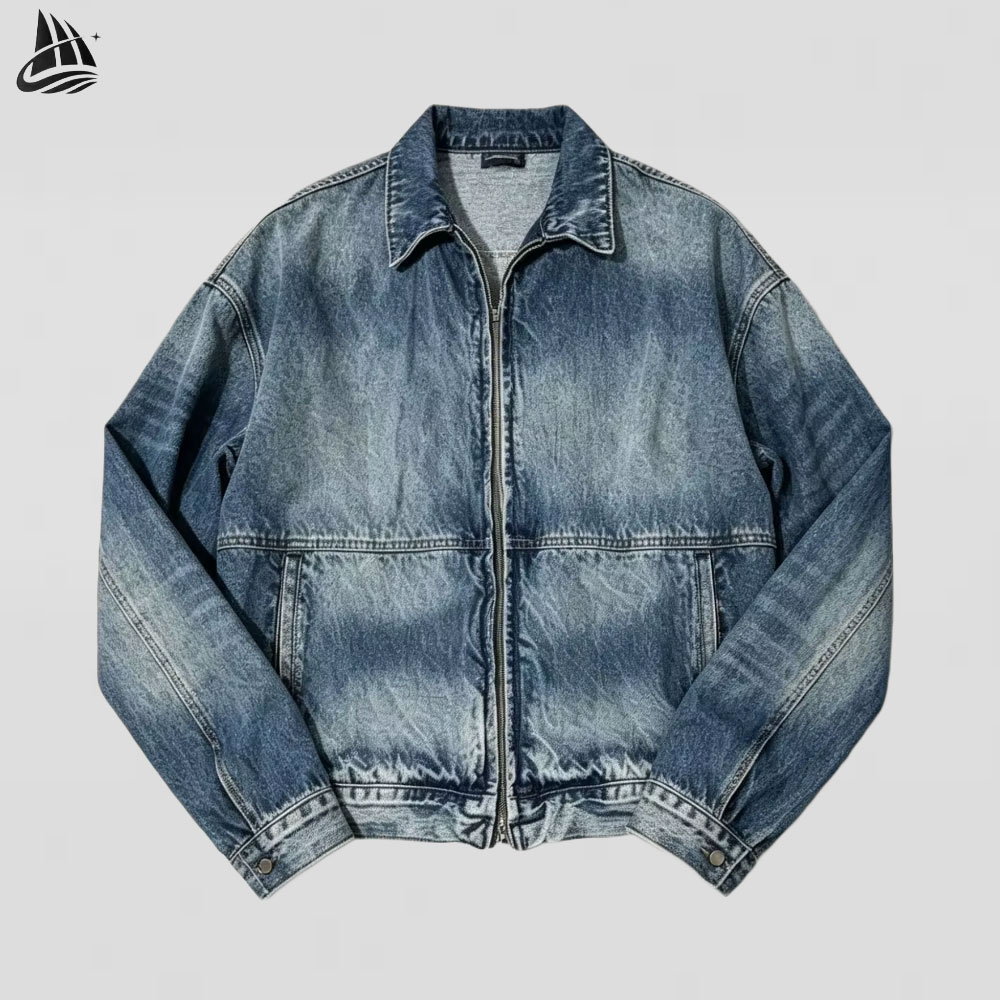
Composition matters for how the jacket ages. Rigid cotton denim creases and fades where it is worn, which is exactly the effect most vintage-inspired jackets are chasing. Denim with stretch recovers faster and fades less dramatically, which is practical for fit but limits how much character develops over time. If the brief is a jacket that looks better after a year of wear, that points one way; if it is a jacket that fits comfortably straight away, it points the other.
Wash Development: What Gets Decided on the Sample
Wash is not a colour selection. It is a recipe applied to a specific fabric, and the result depends on the base shade, the process, the machine and the amount of handling. That is why wash is developed on a sample rather than promised from a photograph: the same recipe on two different fabrics gives two different results.
Common directions include garment washing for softness and shrinkage control, stone or enzyme treatment for surface texture, and hand work for localised fading on seams, pockets and elbows. Each adds a visible effect and each adds process time. The useful question at sampling is not which wash is best but which wash produces the reference look on this fabric.
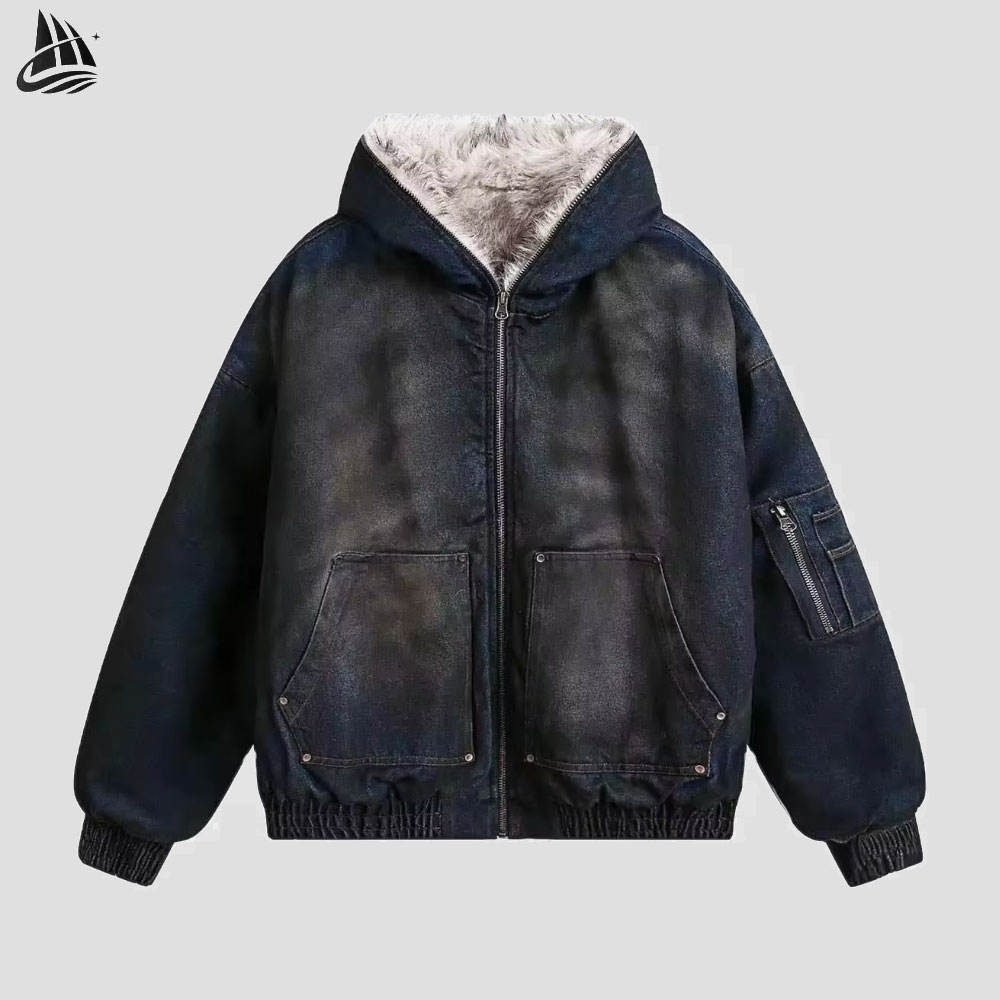
Consistency is the part buyers underestimate. A single jacket can be matched to a reference by eye, but a run of a hundred has to stay within a tolerance across every piece. Ask what the acceptable variation is, and confirm it on the approved sample so both sides are judging against the same thing. Where a wash involves hand work, some variation is inherent; the specification should say how much is acceptable rather than leaving it to discovery at delivery.
Hardware and Trims: Small Parts, Visible Consequences
Buttons, rivets, zips, snaps and labels sit in the hand and at eye level. They are also the parts most likely to be decided late, which is a mistake, because trim minimums often run independently of the garment minimum and lead times can differ.
Finish is the first decision. Bright metal, antique brass, gunmetal, matte black and copper each shift the read of a jacket, and the same button in two finishes looks like two different products. Size is the second: a larger button reads more workwear, a smaller one more refined. Placement is the third, and it is where construction and pattern work together, because moving a button changes the front edge and the buttonhole position.
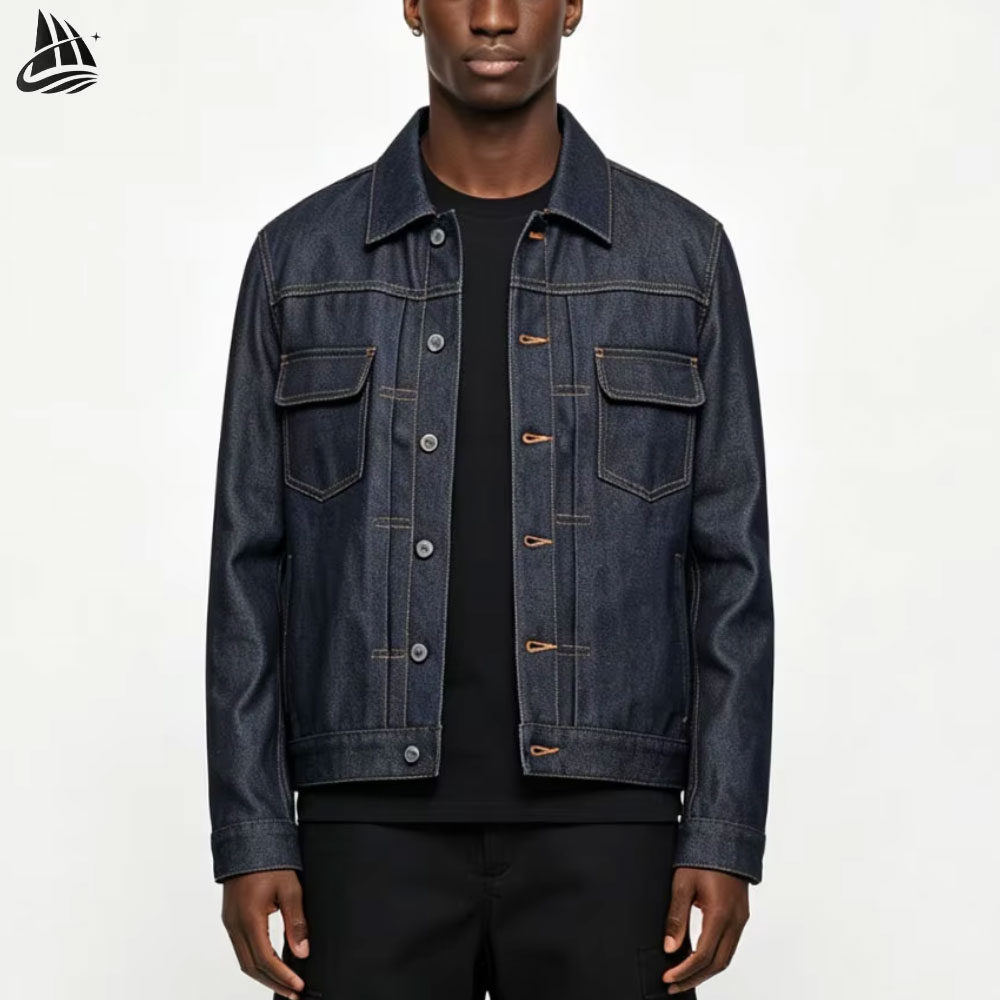
Stitching is a trim decision too. Contrast thread on a dark denim is a strong graphic element, and it changes the perceived weight of the garment. Thread colour has to be approved alongside the fabric, because a thread that reads correctly under a factory light can look different in daylight. Confirm the thread reference on the sample rather than from a colour chip.
Labels and branding follow the same rule. Woven labels, leather patches, printed neck labels and hang tags can all be produced to your branding, but they are best settled before the bulk order is placed rather than added afterwards.
Construction Details That Show in a Finished Jacket
Denim jackets are judged on details that are easy to overlook in a line drawing. Seam type, topstitching density, pocket construction and the treatment of the hem all affect how the jacket sits and how long it lasts.
Flat-felled seams, where the raw edge is folded inside the seam, produce the double line of stitching recognisable on denim. They are stronger than an overlocked seam and they look intentional, which is why they are standard on the front, side and sleeve seams of a denim jacket. Where they are absent, the garment usually reads as a lighter-weight imitation regardless of the fabric.
Pocket construction is the other tell. Patch pockets with bar-tacked corners survive use; pockets sewn with a single line of stitching do not. Adjustable waist tabs, cuff buttons and vent details are similarly functional touches that also carry visual weight, so they are worth specifying rather than leaving to interpretation.
Planning a Denim Jacket Order
The practical sequence is straightforward once the decisions are ordered. Confirm denim weight and composition, agree the wash direction, choose hardware and thread, approve a sample, then cut.
Sampling is charged and quoted upfront, and the sample fee is offset only when the bulk volume is large enough. Sampling takes about two weeks. Bulk production takes three to four weeks after sample approval, and freight by sea, air or land is arranged against the confirmed production schedule rather than assumed in advance.
The minimum applies per colourway. Since a wash is effectively a colour decision, a jacket offered in an indigo wash and a stone wash is two minimums of 100 pieces per style, per color. Consolidating to one wash for the first drop and adding the second on a reorder keeps the first run manageable; small batches and reorders are both supported, and the approved sample and fabric records carry forward so a restock matches the original.
Frequently Asked Questions
Can you match a wash to a denim jacket reference I already own?
Yes, that is the usual starting point. A reference garment is more useful than a photograph because the wash, the fabric weight and the hardware can all be examined directly. Send the reference and the fabric is shortlisted against it, then the wash is developed on a denim jacket sample. Because the result depends on the base fabric, the sample is where the match is judged. It is worth agreeing a tolerance at that stage, since a reference that has been worn for years will have fading that a new garment cannot reproduce exactly.
What denim weights work for a streetwear denim jacket?
Weight is chosen against the silhouette rather than a fixed number. Lighter denim drapes and suits a jacket worn open and loose, while heavier denim holds a boxy shape and takes distressing more visibly. The practical constraint is not the weight itself but how it behaves through the wash, since heavier fabric shrinks and creases differently. That behaviour is measured on the denim jacket sample, and the approved sample becomes the reference for the bulk run so the delivered jacket matches what was signed off.
Are buttons and zips included in the quotation?
Hardware is part of the quoted specification rather than an afterthought. Different finishes, sizes and constructions carry different costs, and some trims have their own minimum quantities that apply independently of the garment minimum. Because of that, hardware is confirmed before the quotation is finalised rather than added later. Sending the intended finish and size with the enquiry means the quote reflects the actual product, and the denim jacket sample is where the hardware is confirmed physically.
How consistent will the wash be across a bulk order?
Consistency depends on the process and on how the tolerance was written. Machine-driven washing on a fixed recipe holds closer than finishes that involve hand work, where some variation is inherent. The specification should state what variation is acceptable, and the approved denim jacket sample is the reference both sides judge against. Inline checks during production catch drift early, and a final inspection before packing compares the finished goods with the approved sample rather than with a general standard.
Can I order two washes in one denim jacket order?
Yes, with the understanding that each wash is treated as its own colourway. The minimum is 100 pieces per style, per color, so a jacket offered in two washes is two minimums. That structure exists because a different wash means a different fabric reservation and a separate process setup. Many brands launch one wash first and add the second as a reorder, which keeps the first run smaller and proves the sell-through before committing to a second process.
What should I send to get an accurate denim jacket quotation?
Send a reference garment or clear images, the intended denim weight or a description of the desired hand feel, the wash direction, the hardware finish and size, the thread colour, and the quantity per style and colour. Artwork for labels and hang tags should be included if branding is involved. With that information the quotation can be built block by block, which also makes it easier to see which specification decision is driving the price before anything is cut.
Start with the fabric, then let the wash and hardware follow.
If a denim jacket is on the table, send the reference, the intended weight and the wash direction, and the specification can be narrowed before sampling begins. Contact our team to discuss a denim jacket development, browse the custom tops range for jackets and shirts, and see the fabrics and processes we work with for washes and finishes. The manufacturing and production page explains how a sample becomes a bulk run.