Screen Print vs DTG vs Hybrid: Choosing for Streetwear
Print is the part of a streetwear style that customers judge first and the part factories get asked about last. A buyer approves a graphic on a screen or a PDF, then discovers three weeks later that the print sits slightly differently on a Navy body than it did on the White sample, or that a photographic artwork lost its detail on the production method that was chosen for cost.
Screen printing, direct-to-garment (DTG) and hybrid combinations are all normal production options. None of them is the right answer on its own. What decides the result is the artwork, the fabric, the order size and how many times the design is expected to repeat.
Key Takeaways
- Screen printing suits flat, limited-colour artwork and long runs: ink is laid through a mesh, so each colour needs its own screen.
- DTG suits detailed or photographic artwork and short runs, because it prints the image directly with no screens to set up.
- Fabric matters as much as the method: ring-spun cotton and tight-knit surfaces hold detail, heavy fleece and textured washes swallow it.
- Hybrid setups — screen base plus DTG detail, or screen plus embroidery — exist to solve one specific problem, not to be a default.
- Decide the method while the artwork is still editable; retro-fitting a finished design to the wrong process is where most print complaints begin.
What Screen Printing Does Well, and Where It Stops
Screen printing pushes ink through a mesh onto the garment, one screen per colour. That opacity is its advantage: on dark garments, a properly built screen print covers the base fabric without the print looking washed out, and the ink film sits on the surface where it will survive repeated washing.
It also scales cleanly. Once the screens are made, the incremental cost per garment falls and the output stays consistent, which is why flat graphics, block lettering and bold one or two-colour front hits are usually built this way. Placement is repeatable, so a run of 800 pieces can look like one print, not 800 prints.
Where it stops is detail. Gradients, fine lines, small type and photographic shading do not translate well into a limited number of flat ink layers. A design can be separated into halftones, but the dot structure becomes visible, and on a textured or heavy washed surface the dots break up further. Screen printing also carries setup work: every colour adds a screen, and every screen has to be registered, which is why very short runs of a multi-colour design become awkward rather than economical.
Two practical notes for heavy garments: on thick fleece, the ink has to be pushed with enough pressure that the print sits on the surface rather than sinking into the pile, and on garment-dyed or acid-washed bodies, the print goes on after the wash so the artwork is not degraded by the process.
What DTG Handles Better
DTG prints the artwork directly onto the garment with a digital head, so there are no screens, no colour separations and no setup per colour. A design with twenty colours costs the same to set up as a design with two. That makes it the natural fit for photographic artwork, fine linework, soft gradients and small chest prints where the customer wants the image to feel part of the fabric rather than laid on top of it.
Its constraint is the surface it prints on. DTG ink bonds to cotton fibres, and the result depends on the pretreat and the fabric face. Ring-spun combed cotton with a smooth, tight knit gives the cleanest result; heavy slub, open-knit or deeply distressed surfaces interrupt the ink. On dark garments, DTG needs a white underbase to hold colour, which adds hand feel — a soft print on a black tee is a different specification than the same artwork on a white tee.
The other constraint is behaviour across a run. Digital output is consistent from the first piece onward, but the garment body is not: a heavyweight boxy tee and a lighter crewneck will not present the same print at the same size. Approving the print on the actual body and colour being produced is the only way to know what the customer will open.
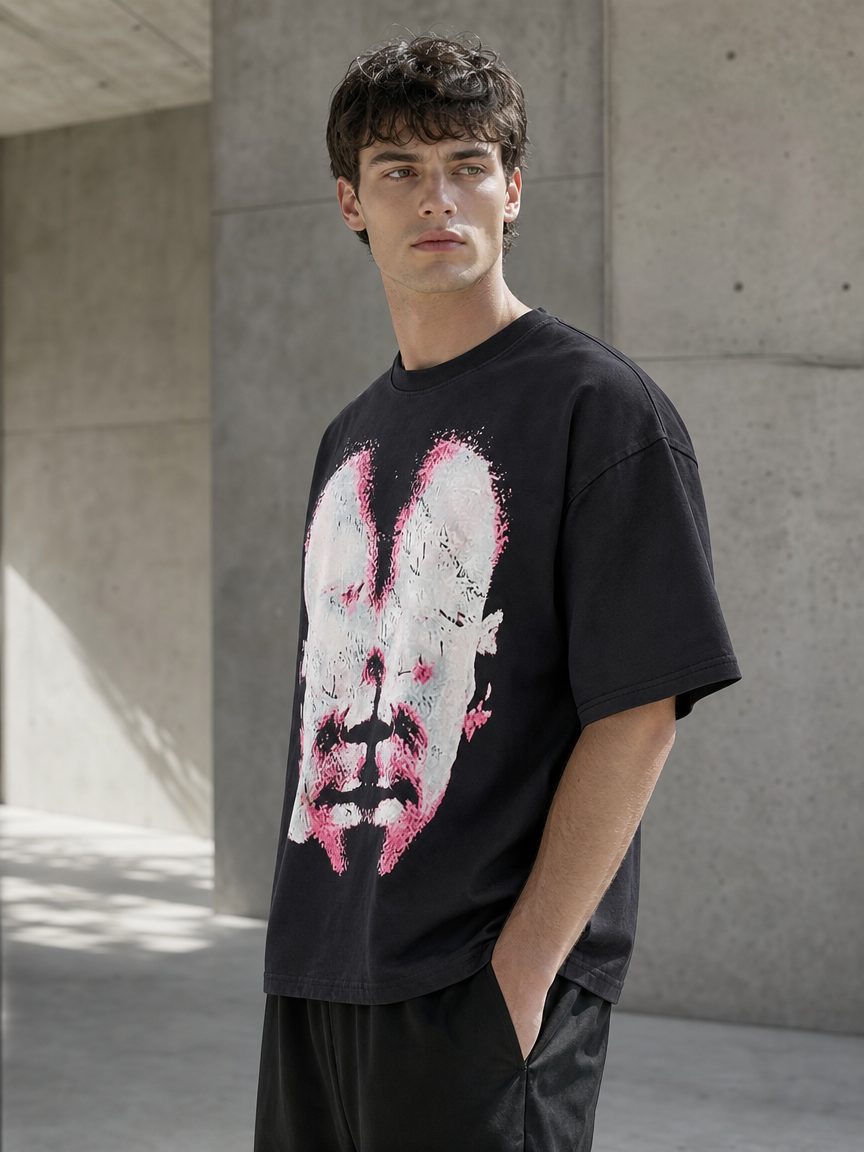
Above: a layered front print on a black body, where the artwork was built for the garment rather than resized onto it. Notice how the graphic uses the fabric colour as part of the design — the same approach works for both direct-to-garment and screen printed graphic t-shirts.
Hybrid Setups and Where They Fit
Hybrid is not a marketing word; it is a way of splitting one design across processes so each part is produced by the method that handles it. The common combinations:
- Screen base plus DTG detail. A solid screen-printed block or large shape carries the graphic, and the fine detail is printed digitally inside it. Useful when a design needs both a strong flat field and photographic elements.
- Screen print plus embroidery. A flat print for the artwork and a stitched element for a wordmark or badge, so the logo reads as texture rather than ink. Common on caps and heavyweight sweatshirts.
- Print plus appliqué or a woven patch. The print carries the background, a sewn element carries the brand. This keeps the printed area smaller on very heavy garments where a large print would sit stiffly.
Each of these adds a step to the production flow and a second thing to approve. They are worth it when the design genuinely needs them, and expensive when they are used to rescue artwork that should have been simplified. The decision point is the tech pack: if the artwork file and the placement diagram do not state which part of the design is printed by which method, the factory will choose, and the choice will be the least demanding one that still passes inspection.
Choosing by Run Size, Fabric and Repeat Pattern
Three questions usually settle the method before any quotation is discussed.
How many pieces, and how many colours in the artwork? Short runs of a detailed, multi-colour design point to DTG. Longer runs of a flat, limited-colour design point to screen printing. A first sample run and a bulk run of the same style do not have to use the same method, but if they differ, the bulk print has to be approved against a bulk-method sample rather than the digital one.
What is the garment? Smooth combed cotton jersey is friendly to both methods. Heavy fleece, textured knits, garment-dyed and acid-washed bodies, and anything with a pronounced surface need a test print before the run is committed. On those surfaces the question is not which method is better but whether the artwork survives at all.
Will the style repeat? A design that will be restocked three times rewards screen printing, because the screens and the approved print standards can be held and reused. A one-off drop or a small capsule with several designs favours DTG, where there is nothing to set up and nothing to store. For buyers planning a repeat, the print specification — mesh count, ink type, cure temperature, print dimensions and the approved strike-off — belongs in the order file next to the fabric reference.
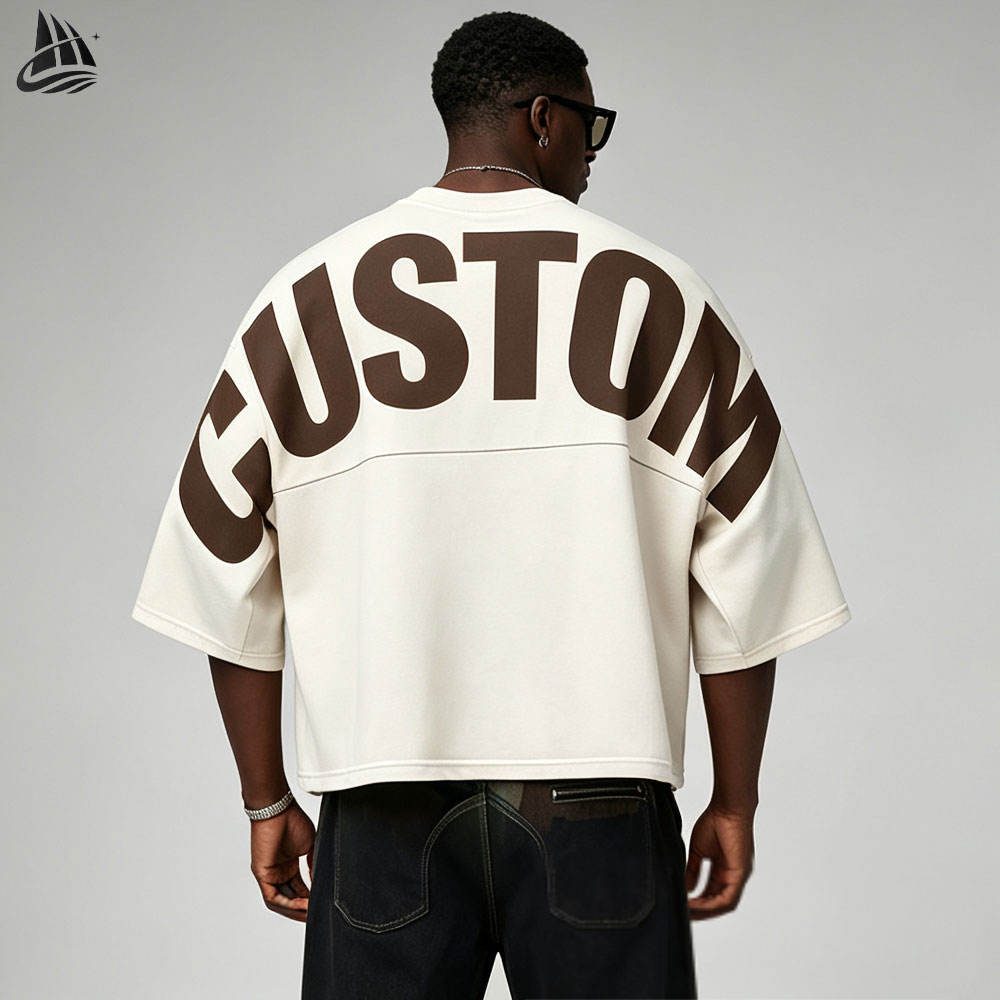
Above: a large back print on an oversized body. Back placements need the print dimension approved against the finished garment width, not the pattern width, because an oversized cut changes where the print lands on the wearer.
Sampling is where these decisions get tested. A print strike-off on the actual fabric, in the actual colour, is a different document from a digital mock-up, and it is the one worth signing. Sampling runs two to three weeks, and the sampling fee is quoted in writing at the start; it can only be offset against bulk when the bulk volume is large enough to absorb it. Minimum order is 100 pieces per style, per colour, with sizes mixable inside a colour, and smaller trial runs can be discussed case by case.
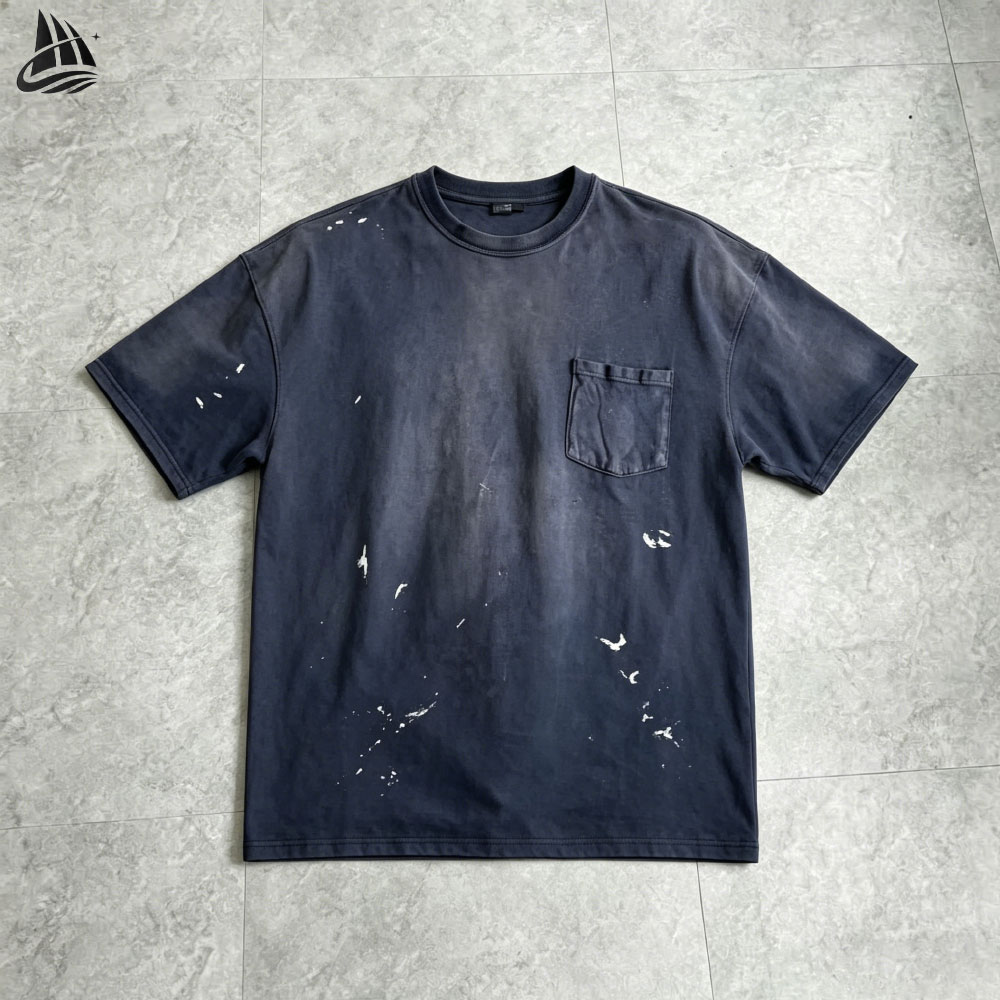
Above: a print applied after garment dyeing, with the wash and the artwork approved together. When the body is washed, the print specification has to be agreed in the same conversation as the colour, or the two will be signed off against different references.
For buyers who want the wider picture on fabric behaviour before print, the site's notes on fabrics and production processes cover the wash and finishing side, and the manufacturing and production section explains how sampling moves into bulk. Ready-made bodies that already suit print work are listed under custom tops.
FAQ
Which is cheaper, screen printing or DTG?
It depends on the run and the artwork, not on the method alone. Screen printing carries setup per colour, which is spread across the run, so it becomes more efficient as quantity rises and the design uses few colours. DTG carries no per-colour setup, so it holds up better on short runs and detailed multicolour artwork. The useful comparison is a quotation for the same body, the same print size and the same placement in the quantity you actually plan to order.
Can DTG print on dark garments?
Yes, with a white underbase. The underbase is what allows colour to hold on a dark body, and it adds hand feel compared with the same artwork printed on a light garment. Because of that, a dark-body print should be approved on its own swatch rather than signed off from a light-garment sample. On very heavy or textured dark fabrics, a test print is worth doing before the run.
How long does a print hold up after washing?
Durability comes from three things: the ink system, the cure, and how the garment is laundered. A correctly cured print on a suitable fabric will outlast the garment in normal wear. What shortens print life is under-curing, printing over a contaminated or heavily finished surface, and washing at high temperature with harsh detergent. Washing inside out in cold water and avoiding direct ironing on the print is the usual care instruction.
Can I mix screen printing and DTG in the same order?
Yes, and it is common on capsule collections where one style carries a large flat graphic and another carries a photographic print. The two are specified separately, sampled separately and approved separately, even when they ship together. What should not happen is a mid-run switch from one method to the other without a new approval, because the customer will compare the two garments side by side.
What artwork file do you need for printing?
A vector file for flat graphics, and a high-resolution raster file for photographic work, with the print size and placement marked on a garment diagram. Colour references should be stated as physical references or standard colour codes rather than screen values, since a monitor colour is not a print specification. Artwork that is already flattened, low resolution or built only as a mock-up will need to be rebuilt before sampling.
Do you handle embroidery as well as print?
Yes. Embroidery is often the better choice for wordmarks, small badges and cap fronts, where a stitched element reads as texture rather than ink. Print and embroidery can be combined on one garment, and on heavyweight styles that combination is often what makes the design feel finished rather than applied.
Next step. Send the artwork, the body you have in mind and the quantity you are planning, and the print method will be recommended with the sampling position stated up front. Contact our team to start the review.