Tech Pack for Clothing Manufacturing: A Buyer's Guide
A tech pack is the document that turns your idea into something a factory can quote, sample and produce without guessing. Brands that arrive with one usually get a faster, more accurate quotation. Brands that arrive without one spend weeks in email loops, pay for samples that come back wrong, and may only discover at bulk stage that the fit, the colour or the trim was never agreed.
This guide covers what a clothing tech pack is, which pages matter most, and the mistakes that cause failed samples.
Quick answer: A tech pack is your product specification package — flat sketches, measurements and tolerances, construction and stitch details, fabric and trim specifications, colour references, artwork placement, labelling and packaging. It is what a manufacturer quotes from and samples against. You do not need a design degree, but every page has to be unambiguous. The standard MOQ is 100 pieces per style, per color, so getting the specification right at sampling is what protects your budget.
Key Takeaways
- A tech pack is the source document for quotation, sampling and bulk inspection; if it is vague, every step after it is vague too.
- The five pages that cause the most failed samples are the measurement chart, construction details, fabric spec, colour references and artwork placement.
- Tolerances matter more than exact numbers — a measurement without a tolerance cannot be checked or rejected.
- You can start without a complete tech pack: reference garments plus a written brief get sampling moving.
- INFULLSAIL is a Dongguan-based OEM and ODM clothing manufacturer with more than 20 years of apparel experience; sampling is quoted up front, typically takes one to two weeks, and bulk production typically runs three to four weeks after sample approval.
What a Tech Pack Is — and What It Decides
A tech pack is not artwork or a mood board. It is a specification: the written and drawn definition of the garment you want to sell — what a merchandiser quotes from, a pattern maker builds from, and a quality controller inspects against.
That is why it decides more than people expect:
- Your price. Every panel, seam, wash step and decoration pass becomes time and material in the quotation. A pack that leaves the finish ambiguous is quoted with assumptions, and assumptions get renegotiated later.
- Your launch date. A complete pack shortens the question-and-answer phase before sampling. Because sampling typically takes one to two weeks and bulk runs three to four weeks after approval, days lost to clarification are days added to your launch.
- Whether you can reorder confidently. The pack recording the approved measurements and finish is what your second run is built from, so a reorder looks like the first order instead of a new guess.
- Whether you can leave. If the specification lives only in a supplier's inbox, moving to another factory means rebuilding everything. If it lives in your own document, you can source a different style elsewhere without starting over.
That discipline exists as recognised method: ISO 9001:2015 (clause 8.3) treats design and development as a planned activity with defined inputs, review steps and outputs — the same logic, applied to a garment, so what you approved is what you receive.

The Pages a Working Tech Pack Needs
You do not need a hundred pages. You need these, and each one has to be checkable.
- Cover and style summary. Style name or number, season, category, target market and size range, with a current date.
- Flat sketches — front, back and detail views. Line drawings, not photographs, with seams, pockets, closures and topstitching visible.
- Measurement chart with points of measure. Every measurement needs a named point of measure and a tolerance. A 56 cm chest width with no tolerance cannot be approved or rejected later.
- Grading rules across the size range. How the garment grows from size to size, including extended sizes — grading you can trust in every size, not just the fit sample.
- Construction and stitch details. Seam types, stitch density, hems, bartacks, needle and thread direction. This page most changes how the garment feels in the hand.
- Fabric specification. Composition, construction, weight as mass per unit area (the basis of ASTM D3776), stretch direction and a hand-feel reference. A fabric family alone leaves room for substitution, which is how you end up selling a product you did not design.
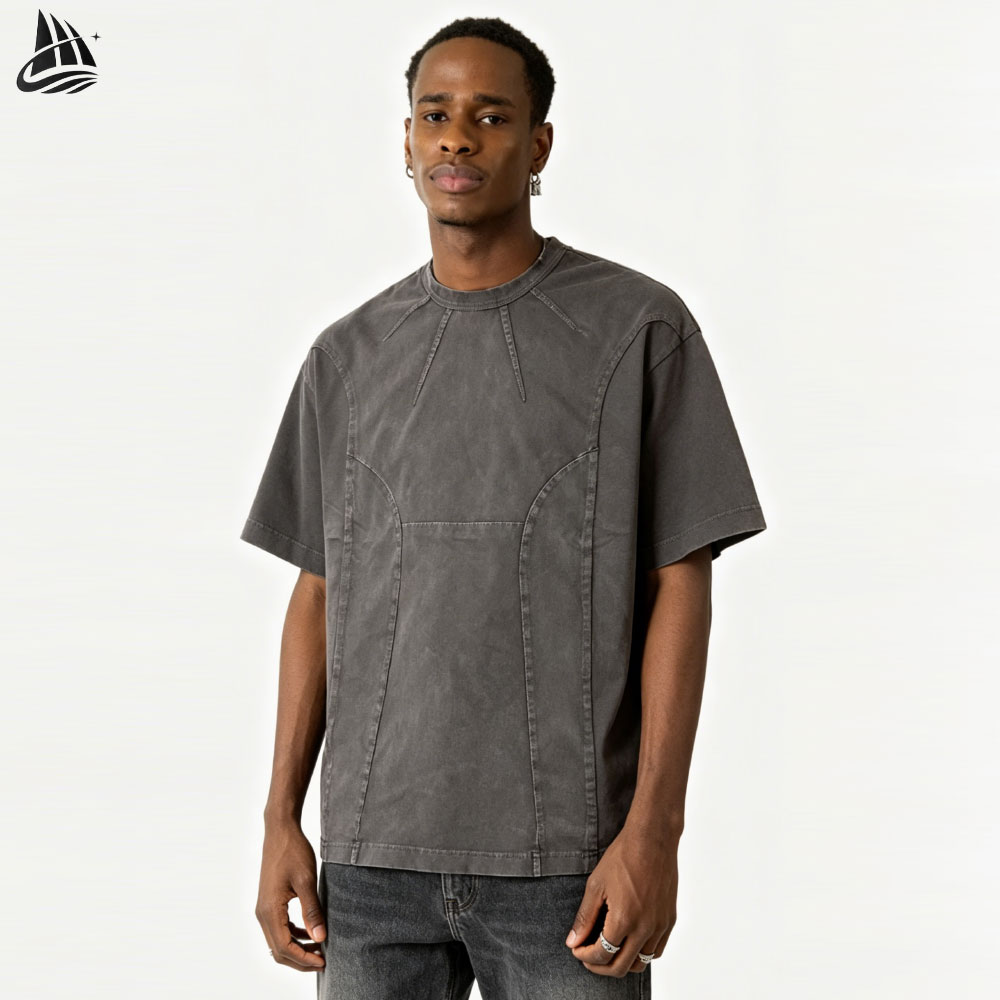
- Wash and finish specification. Wash type, intensity or reference swatch, softener target, and the sequence relative to decoration. In washed and vintage streetwear this page and the print page interact: reverse the order and the print breaks down in the wash.
- Colour references. Swatches for fabric, thread, trims and print, and which one is master. Colour approved from a phone photo gets argued about later.
- Artwork, print and embroidery placement. Files with dimensions, position from a fixed datum point, colours and a per-size scaling rule, so a small and an XXL read as the same product.
- Labels, packaging and packing. Main label, care label, hangtag, polybag, carton marking, and whether you need flat-packed or pre-packed units. Care labelling follows a published system — ISO 3758:2012 sets out the care symbols and their meaning — so your garment can be read in any market.
How fabric choice feeds construction, wash and finishing is set out on our Fabrics and Processes page, and the order those stages follow is covered under Manufacturing and Production.
Where Tech Packs Go Wrong — and What It Costs You
Most failed samples trace back to five recurring gaps.
- Measurements without tolerances. The sample measures 55.6 cm against a 56 cm spec. With no stated tolerance, nobody can say whether that is acceptable — and the argument lands on your launch date.
- Fabric named by feel instead of by specification. "Heavyweight cotton" is not a specification. When the substitute arrives lighter or shrinks differently, the fit you approved no longer exists after the first wash.
- Decoration sequence left open. Print placement is confirmed, but nobody states whether printing happens before or after the wash. One sequence gives a soft vintage print; the other gives a cracked one.
- Colour communicated by photograph. Screens render colour differently from fabric, so approvals given this way become rework or a colourway you did not plan.
- Labelling treated as an afterthought. Missing care symbols or fibre composition can hold a shipment at customs in markets that require them — cheap to fix at the pack stage, expensive after the goods are cut.
The pattern is the same in all five: an open question in the pack becomes a paid answer later — a re-sample, rework or a slipped launch. An approved-sample photo and the signed measurement sheet close most of that gap.

Tech Pack vs Pattern vs Sample: How They Fit Together
Buyers often use these three words as if they were one step. They are different things, and knowing which one you own changes how you work with a manufacturer.
- The tech pack is yours. It is the specification. A factory can improve it, but the intent has to come from you.
- The pattern is the engineering. It converts measurements into cuttable shapes and grading rules. In OEM development it is built for you; in ODM it already exists and is adapted to your specification and trims.
- The sample is the proof. It verifies that pack and pattern agree, and it becomes the approved reference for bulk. A sample approved without a signed measurement sheet is an approval you cannot enforce later.
If you already have patterns, bring them — they shorten development and give you a second source later. If you only have reference garments, send them with the brief; a factory that develops washed and vintage streetwear can work from a physical reference plus your written intent. Our Retro Clothing Manufacturing Solutions page explains how those styles are developed.
Briefing a Manufacturer From a Tech Pack
A pack is only as good as the brief that carries it. Send it with these attached:
- The tech pack version and date you want quoted, not three older drafts.
- Reference garments or photos showing the hand-feel direction you are aiming for.
- Fabric and trim sources you already have, or a clear statement that you need options.
- Your size range, including extended sizes, and your target market, so labelling is right the first time.
- Colour references and artwork files in their working formats.
- Your target launch date, so sampling and production are planned against it rather than fitted around it.
- A single approver on your side — approval loops with three stakeholders are where sample rounds multiply.
Ask for a quotation that itemises development and sampling, fabric, trims, decoration, production, packaging and shipping rather than one total, so you can see which specification choices drive cost. Sampling is a paid step at INFULLSAIL and the fee is quoted clearly before work begins, so nothing surfaces on a later invoice. Samples are typically completed within one to two weeks, and bulk production typically runs three to four weeks after sample approval. Reorders run against the approved specification on file, which makes a repeat drop predictable instead of a fresh gamble.
FAQ
Do I need a tech pack to get a quotation?
No, but you will get a more accurate one with it. Without a pack, a manufacturer quotes using assumptions about fabric weight, construction and decoration, and the price moves once those are settled. With a pack — or at least a written brief and a reference garment — the quotation reflects what you intend to sell.
Can I write a tech pack myself?
Yes. Brands do it with a spreadsheet and flat sketches, and many start from a simple template. What matters is not the format but whether each measurement has a point of measure and a tolerance, and whether fabric, colour, decoration and labelling are specified rather than described.
How detailed should the measurement chart be?
Detailed enough that someone who has never spoken to you can check the garment against it. Every measurement needs a named point of measure, a base size value, grade increments and a tolerance, so sample and bulk are compared against the same numbers instead of an opinion.
What is the difference between a tech pack and a spec sheet?
A spec sheet is usually one page — key measurements and materials. A tech pack is the full package: sketches, construction, grading, care and labelling, artwork placement and packaging. If you sell into retail or wholesale, the fuller document is what keeps repeat orders consistent.
What MOQ should I plan for?
The standard MOQ is 100 pieces per style, per color. Planning your size range and colourways around that keeps a first order efficient, and it is also why a complete tech pack pays for itself: fewer sample rounds and fewer corrections on a 100-piece run protect your margin. Lower-volume trial orders can be discussed case by case depending on the style and the processes involved.
Send Your Tech Pack for a Development Review
Send your tech pack, reference garment or written brief along with your size range, fabric direction, decoration plans, target market and target launch date. We will reply within one business day with a development plan, a clear quotation that includes the sampling fee up front, and a note on anything in the specification likely to cause a failed sample. Share it through our contact page and we will take it from there.