Heavyweight Cotton Explained: 240GSM to 500GSM for Streetwear
Two t-shirts can both be called heavyweight and feel nothing alike. One stands away from the body like a box, holds a screen print flat and keeps its shape after a year of washes. The other feels firm on the hanger and then collapses at the first wear. The number on the spec sheet is the same, which is why buyers who specify fabric by weight alone keep receiving garments they did not intend to order.
Grams per square metre is the starting point, not the answer. Here is what 240, 300, 380 and 500 GSM cotton actually does on a streetwear garment, and how to write a fabric line into a tech pack so the bulk matches the sample.
Key Takeaways
- GSM measures fabric weight per square metre; it does not describe yarn count, knitting tension or finish, so two fabrics at the same GSM can feel and drape differently.
- For streetwear tees, 240 to 260 GSM reads as a substantial mid-heavy cotton, 300 to 340 GSM holds a boxy silhouette, and 380 GSM and above behaves more like a light sweatshirt than a t-shirt.
- Heavier fabric costs more per garment in fabric consumption and sewing time, and it needs stronger seams, heavier rib and a print method that suits a dense surface.
- Shrinkage and finish change the final weight and hand feel, so fabric approval and wash approval belong in the same round.
- Approve the fabric on the finished garment in your colour, not on a swatch card, and keep the approved swatch with the order file for reorders.
What GSM Actually Measures
Grams per square metre is the mass of one square metre of fabric. It is a weight, not a thickness, and not a quality grade. A loosely knitted heavy yarn and a tightly knitted finer yarn can land on the same number while behaving like different materials, because what a customer feels is the combination of yarn count, knitting tension, surface finish and the garment's cut.
Finishing moves the number too. Washing, compacting and dyeing all shift the measured weight slightly, and a garment-dyed style can come out denser than the greige fabric it started from. That is why a specification quoting a single figure with no tolerance is hard to hold: quote a target weight with an acceptable range, and confirm it with a fabric test report on the lot being cut. Composition matters as much — cotton, cotton-poly blends and cotton with a little elastane behave differently at the same weight, and a heavier fabric with low-grade yarn can feel rougher than a lighter one with better yarn.
240 to 500 GSM: What Each Range Does on a Garment
The bands below describe how cotton jersey and fleece behave on real streetwear shapes. They are working ranges rather than official categories, and the exact hand feel still depends on the mill, the yarn and the finish.
180 to 220 GSM is standard t-shirt ground. It drapes, it is cool in heat, and it shows the body. It suits retail basics, but it does not hold a boxy shape.
240 to 260 GSM is where a tee starts to feel substantial. The fabric has enough body to sit slightly away from the chest, the neckline holds better, and screen printing lands cleanly without ink sinking into a thin surface. This is the entry point most brands mean when they say heavyweight, and it is the most wearable of the heavy bands because it still behaves like a t-shirt.
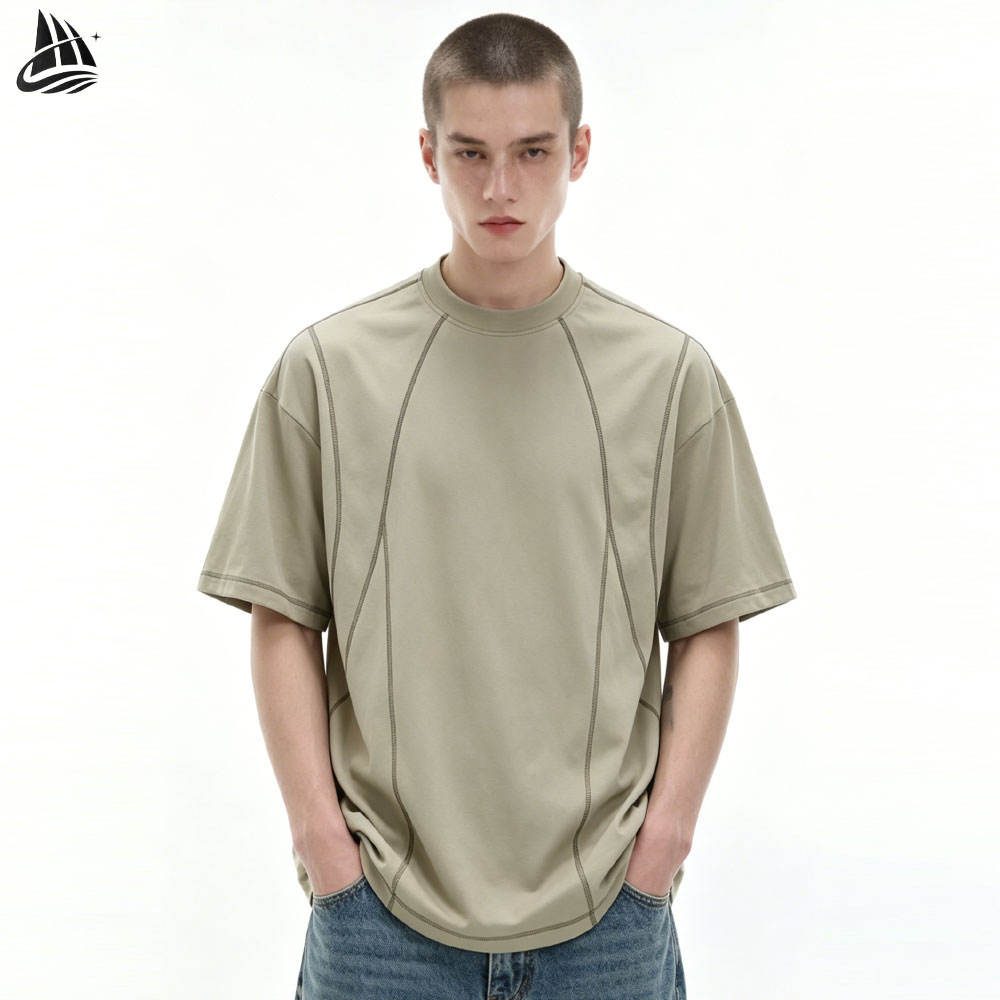
Above: a mid-heavy cotton tee with contrast stitching. At this weight the shoulder seam sits with a slight lift rather than following the body, which is the visual difference buyers notice first.
300 to 340 GSM is where the silhouette changes. The fabric stands up on its own, drop shoulders read as deliberate, and a boxy cut stays boxy through the day instead of collapsing at the waist. It is heavier to wear and slower to dry, and it needs a firmer rib at the collar and stronger seam construction, because a dense fabric pulls harder on every stitch line.
380 to 450 GSM moves into sweatshirt territory. A tee built at this weight holds structure, it is warm, and it is stiff until it has been washed a few times. Prints sit high on the surface, which suits puff and high-density work and can look heavy in a flat single-colour print. Pattern making has to account for the fabric's resistance at the armhole and neck, or the garment feels restrictive rather than oversized.
500 GSM and above is dense loopback and heavy fleece ground, used for hoodies and crewnecks rather than tees. Garments at this weight need industrial machines, reinforced seams and careful grading, and they consume a lot of fabric. The right answer for cold-weather outer layers, the wrong answer for anything meant to be worn in heat.
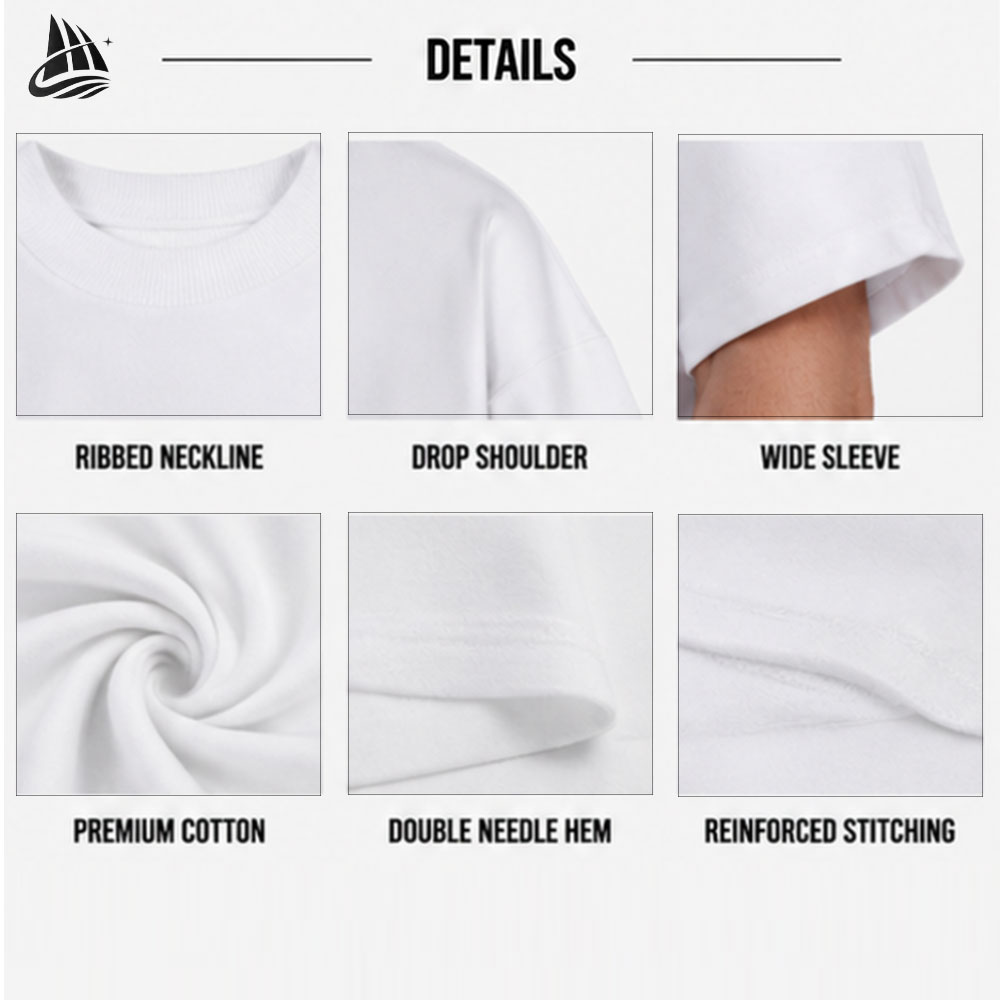
Above: an oversized body with a ribbed neckline and drop shoulder. Heavy bodies hold this shape; a light jersey at the same cut collapses at the waist within a wear.
Construction Details That Decide Whether Heavy Fabric Works
Heavy cotton is not a light tee made from thicker cloth. Every construction point has to carry more load.
Seams come first. Dense fabric does not compress under the needle, so a standard overlock on a 380 GSM body leaves a ridge and can pucker along the side seam. Coverstitch or flatlock spreads the load, and seam allowances have to be trimmed so the inside does not feel like a set of ropes. On shoulder seams, taping or a reinforced stitch stops the seam stretching under the weight of the panel.
The collar is second. Rib that works on a 200 GSM tee goes slack on a heavy body, because the fabric around it is stiffer and pulls differently. A denser, slightly narrower rib holds the neckline, and this is the detail most often missed when a sample is approved from a photo rather than handled in person.
Then there is print. On 240 to 260 GSM cotton, plastisol and water-based inks both behave predictably. On 380 GSM and above the surface is denser and less absorbent, so ink sits higher, curing times change, and a large solid print can stiffen the chest panel noticeably. Embroidery on heavy cotton needs a backing that suits the fabric and a stitch count that does not distort the panel — the same reasoning that governs fabric selection and finishing processes across the rest of the range.
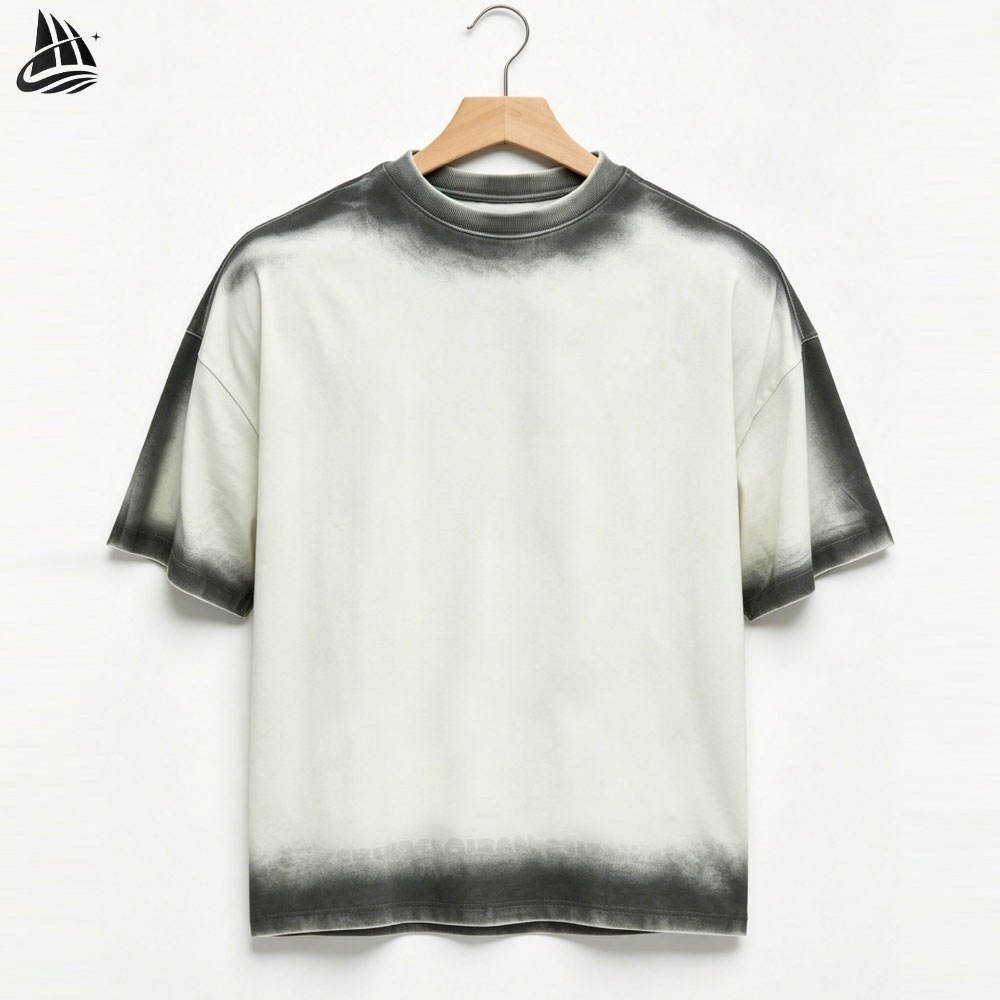
Above: a dip-dyed body. Dyeing and washing change both the measured weight and the hand feel, so the fabric and the finish have to be approved together.
Weight, Shrinkage and Cost in the Tech Pack
A fabric line a factory can produce from states five things: construction, composition, weight with a tolerance, finish, and the shrinkage allowance the pattern was cut to. "Heavy cotton tee" is a description. "Single jersey, cotton-rich, 300 GSM plus or minus five percent, pre-shrunk, garment washed" is a specification both sides can check.
Shrinkage is where heavyweight orders most often go wrong. Dense cotton knits can shrink noticeably on the first wash if the fabric was not pre-shrunk and the pattern was not cut with an allowance. The result is a garment that fits at inspection and is a size smaller after the customer's first laundry cycle. State the allowance, cut to it, and verify it with a wash test on the bulk fabric rather than relying on how the sample behaved.
Cost follows weight directly: heavier fabric consumes more metres per garment, sewing takes longer, and the finished goods weigh more in freight. A brand moving a tee from 220 to 300 GSM should expect landed cost per unit to rise on all three counts, which is why the weight decision belongs with the pricing conversation rather than after it.
The right weight is a function of the product, not of a trend. A drop meant for a warm market is badly served by 380 GSM cotton no matter how good it photographs, and a boxy piece meant to hold shape looks thin at 220 GSM. Start from the garment's job, test it on the sample, and keep the approved swatch, weight and tolerance, finish and lab dip in the order file.
Sampling is where the fabric decision gets tested. Sampling runs two to three weeks, the sampling fee is quoted up front and can only be offset against bulk when the bulk volume is large enough to absorb it. Minimum order is 100 pieces per style, per colour, with sizes mixable inside a colour, and smaller trial runs can be discussed case by case.
For a same-family comparison of how back constructions behave at similar weights, the notes on french terry, fleece and loopback cover the sweatshirt side of the question. Ready body shapes across weights are listed under custom tops, and the sequence from sample approval to bulk is set out under manufacturing and production.
FAQ
What GSM is considered heavyweight for a t-shirt?
In streetwear, 240 GSM and above is generally treated as heavyweight, and the practical band runs from about 240 to 340 GSM. Above roughly 380 GSM the fabric starts to behave like a light sweatshirt: it holds structure strongly, it is stiff until washed, and it needs stronger seam and rib construction. There is no single official threshold, so read the number together with the construction and finish.
Is higher GSM better quality?
No. GSM describes weight, and weight is a design choice rather than a quality grade. A 220 GSM tee with good yarn, even knitting and a clean finish is a better garment than a 340 GSM tee with poor yarn and uneven seams. Quality shows in the yarn, the dyeing, the construction and the inspection standard, none of which appear in the weight figure.
Can heavyweight cotton be printed and embroidered?
Yes. On 240 to 260 GSM, plastisol and water-based screen printing both behave predictably. On 380 GSM and above the surface is denser, so ink sits higher, curing times adjust, and large solid prints can stiffen the panel. Embroidery on dense cotton needs a suitable backing and a stitch count that does not distort the panel. On washed styles, approve the print or embroidery on the finished, washed garment.
How much more does a heavier fabric cost?
More, on three counts: heavier fabric consumes more metres per garment, sewing takes longer, and the finished goods weigh more in freight. The exact difference depends on the fabric and the style, and it is quoted per order rather than assumed from the weight alone.
What is the minimum order for a custom heavyweight tee?
The minimum is 100 pieces per style, per colour, with sizes mixable inside a colour. Sampling runs two to three weeks, and the sampling fee is quoted up front and can only be offset against bulk when the bulk volume is large enough to absorb it. Smaller trial quantities can be discussed case by case, and bulk production typically runs three to four weeks after sample approval.
How do I keep the same fabric on a reorder?
Keep the approved swatch, the composition, the weight with its tolerance, the finish and the lab dip in the order file, and match the repeat run to those references rather than to the previous shipment alone. If the original lot is no longer available, the new lot is matched to the approved standard and re-approved on a swatch, and if the finish changes, the colour approval is repeated with it.
Next step. Send the weight you have in mind, the silhouette and the finish, and the fabric position will be confirmed with the sampling timeline before anything is cut. Contact our team to start the review.