Custom Knitwear — Gauge, Yarn and Structure Explained
Quick Answer
Knitwear is specified by gauge, yarn and panel construction, and those three decide the hand feel, the price and whether the garment keeps its shape.
- 12 gauge gives a fine face around 180–220 GSM; 7 gauge gives 300–400 GSM.
- Full-fashioned panels waste 8–12% less yarn but run slower.
- Unrelaxed cotton knit loses 3–5% of body length on the first wash.
Two knit shirts can weigh the same and feel like different materials. One has a dense, even surface that holds a collar; the other is soft, slightly open and collapses at the shoulder after a month. The difference is not the fibre — it is the gauge, the yarn count and the way the panels were shaped.
That matters commercially because knitwear is priced by machine time, not by fabric metres. A 3 gauge chunky knit runs a fraction of the speed of a 12 gauge fine knit, and a full-fashioned panel cannot be cut from a roll. Get the gauge and the panel method wrong and the quotation moves by a third before anyone has discussed the colour.
This guide sets out the three decisions in the order they affect the garment, with the numbers to specify and the failures each one produces.
Gauge
What does gauge actually mean in knitwear?
Gauge is the number of needles per inch across the needle bed. It sets the finest stitch the machine can make, and therefore the smallest detail the design can carry.
| Gauge | Needle pitch | Typical weight | Where it belongs |
|---|---|---|---|
| 3 gg | ~8.5 mm | 500 GSM and above | Chunky outer layers, heavy cardigans |
| 5 gg | ~5.1 mm | 400–500 GSM | Heavy sweaters, cable panels |
| 7 gg | ~3.6 mm | 300–400 GSM | Standard streetwear knit, visible stitch |
| 12 gg | ~2.1 mm | 180–220 GSM | Fine knit shirts, lightweight layers |
| 14 gg | ~1.8 mm | 150–190 GSM | Fine-gauge shirting, dressier surfaces |
Weights are working ranges for cotton and cotton-blend knits; actual GSM depends on yarn count, stitch structure and finishing.
The practical consequence is stitch scale. The weight bands that sit alongside gauge are covered in the guide to heavyweight cotton GSM ranges, and the fabric side of the same question sits under fabrics and processes. A cable that reads as a 40 mm wide rope on 7 gauge becomes a 15 mm cord on 12 gauge, and the same design file produces two different garments. If a buyer approves a sample on one gauge and orders on another, the pattern has to be redrawn rather than resized.
Yarn
How do you compare yarn counts between mills?
Yarn is quoted in two numbers, and both matter. The count describes thickness in Nm or Ne, and the ply describes how many strands are twisted together.
A 2/28 Nm cotton is two strands of 28 Nm yarn plied together — a standard fine-knit cotton for 12 gauge. A 2/30 Nm is slightly finer and gives a cleaner surface. A 1/15 Nm is a single, thicker yarn used on 5 and 7 gauge where the stitch is meant to look substantial.
Ply is not a quality badge on its own. A well-spun 1/15 Nm yarn on a 7 gauge machine makes a better garment than a loosely twisted 2/28 Nm used outside its gauge. What ply does change is stability: plied yarns resist abrasion at the stitch loop, which is where pilling starts.
Where this goes wrong A buyer approved a 12 gauge sample in 2/28 Nm cotton, then accepted a mill substitution to a softer 2/32 Nm yarn to hit a price. The garment came back 15 GSM lighter, the neckline lost its recovery, and the wash test showed 6% length shrinkage against a 3% target. The yarn was not defective — it was the wrong yarn for that gauge and that collar.
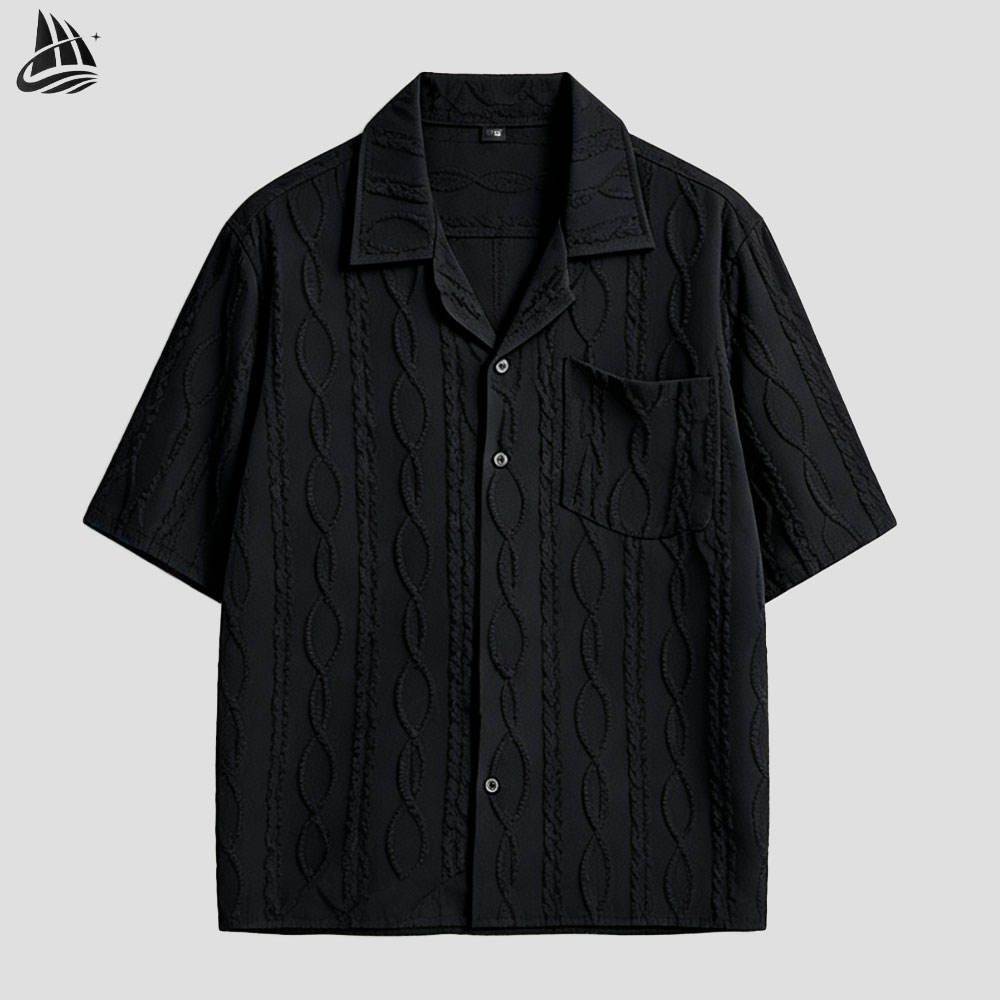
Front view. Cable panels read at a fixed physical width, so the same cable on a coarser gauge occupies fewer stitches and changes the proportion of the body.
Structure
Which knit structure suits which silhouette
Structure decides stretch, recovery and surface. It is the second thing that moves once gauge is fixed.
| Structure | Behaviour | Use for | Risk |
|---|---|---|---|
| Single jersey | Light, drapes, curls at edges | Fine knit shirts, lightweight layers | Hem and neckline need rib or binding |
| 2×2 rib | High stretch, strong recovery | Cuffs, hems, collars, fitted bodies | Slow to knit; narrows the garment |
| Cable panel | Adds thickness and vertical texture | Statement fronts, heavy sweaters | Pulls the panel narrower by 10–15 mm |
| Jacquard | All-over pattern in the knit | Graphic knitwear without printing | Extra yarn floats; heavier and stiffer |
| Intarsia | Separate colour blocks | Large placed graphics | Hand-finished joins; slowest of the five |
Two structural facts catch buyers out. First, a cable panel pulls in: a 300 mm front panel with a 40 mm cable finishes 10–15 mm narrower than the flat measurement, which is why the pattern has to be drafted with the cable in place rather than added afterwards. Second, rib is not a trim — a 2×2 rib body changes the fit of the whole garment, because it contracts by roughly 20% at rest and stretches back to the body.
Panels
Full-fashioned or cut and sew
This is the cost decision. Full-fashioned panels are knitted to shape; cut-and-sew panels are knitted as a flat piece and cut like woven fabric.
| Method | Yarn waste | Lead time impact | Best for |
|---|---|---|---|
| Full-fashioned | Low, typically 3–6% | Longer; each panel is a separate machine programme | Visible shaping, better drape at the armhole, premium hand feel |
| Cut and sew | Higher, typically 12–18% | Shorter; panels knit as one wide piece | Simple shapes, heavy textures, lower cost at volume |
| Hybrid | Mid, typically 8–12% | Fashioned body, cut sleeves | Styles where the body needs shaping but the sleeve does not |
The visible difference is at the seam. A full-fashioned armhole has a shaped edge that links stitch to stitch, so the seam lies flat and the garment keeps its line through the shoulder. A cut-and-sew armhole has a cut edge that must be overlocked, which adds bulk and can show through a fine gauge.
Where cut-and-sew wins is heavy texture. A 5 gauge cable panel is difficult to fashion cleanly, and cutting it after knitting is both faster and more predictable. The rule of thumb: fine gauges reward fashioning, coarse gauges tolerate cutting.
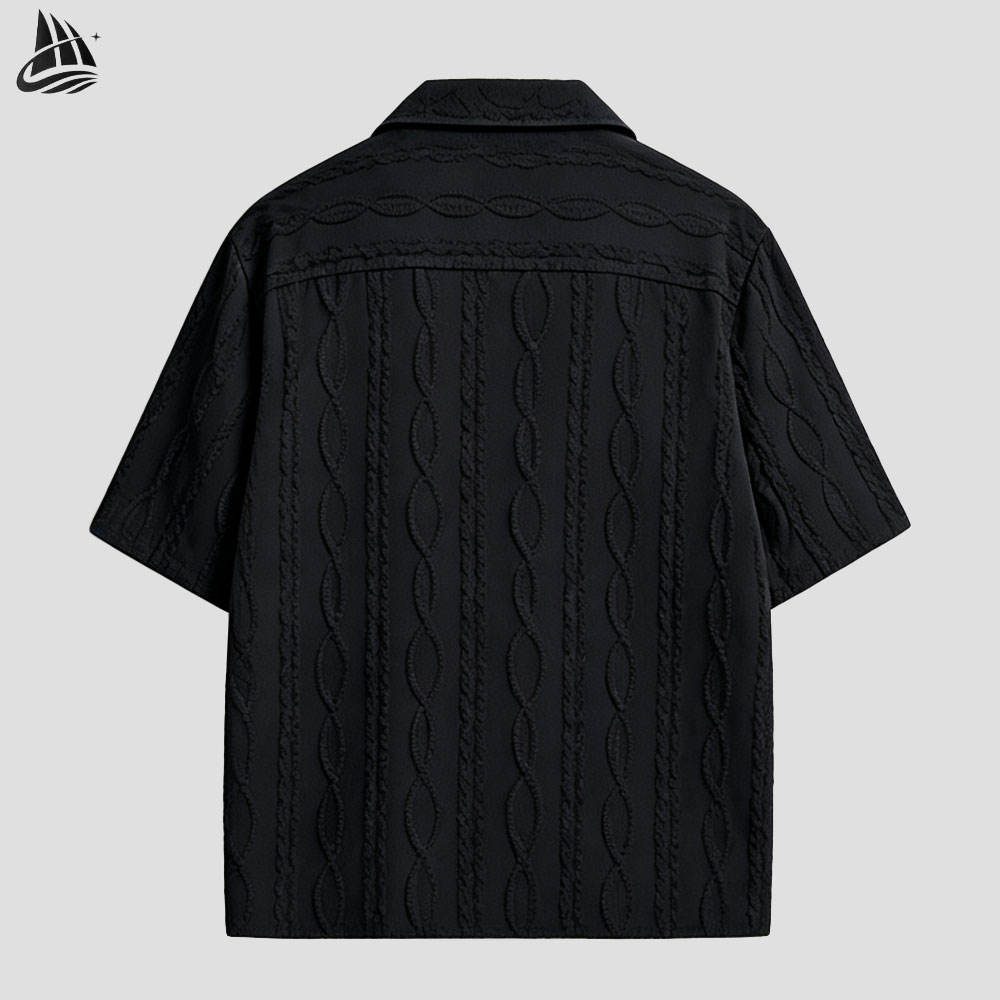
Rear view. On a linked shoulder the seam follows the stitch line rather than a cut edge, which is what keeps the shoulder from developing a ridge after washing.
Making up
How do you link a knit seam so it does not ridge
Knitted panels are joined by linking, not by sewing. Linking matches stitch to stitch on a dedicated machine, and the seam inherits the stretch of the knit rather than fighting it.
Three seams decide whether the garment feels factory-made or cheap: the shoulder, the armhole and the neck. A linked shoulder moves with the body; an overlocked one creases at the top of the shoulder within a few wears. The neckline is the most sensitive, because it is the seam the customer touches first and the one that fails first.
Rib necks should be linked or hand-finished, and the rib itself should be knitted at a slightly tighter gauge than the body so it recovers. Cutting a rib from body fabric and attaching it is the most common shortcut, and it is visible in the hand within one wash.
Shrinkage
How much does a knit garment shrink after washing?
More than a woven, and the amount depends on whether the yarn was relaxed before knitting and whether the panel was washed before cutting.
Cotton knit at 12 gauge typically loses 3–5% of body length on the first 40 °C wash if it has not been relaxed. Wool and wool blends can move further, 5–8%, unless the yarn is treated. A garment cut to the greige measurement and not compensated will be one size short on the customer's first laundry cycle.
The control is a wash test on the actual bulk yarn — the same principle that governs hoodie measurements and shrinkage allowances on cut-and-sew styles — not on the sample's yarn: five cycles at 40 °C, measured flat against the approved sheet. The allowance is then cut into the pattern, and the residual shrinkage target is written on the specification rather than assumed.
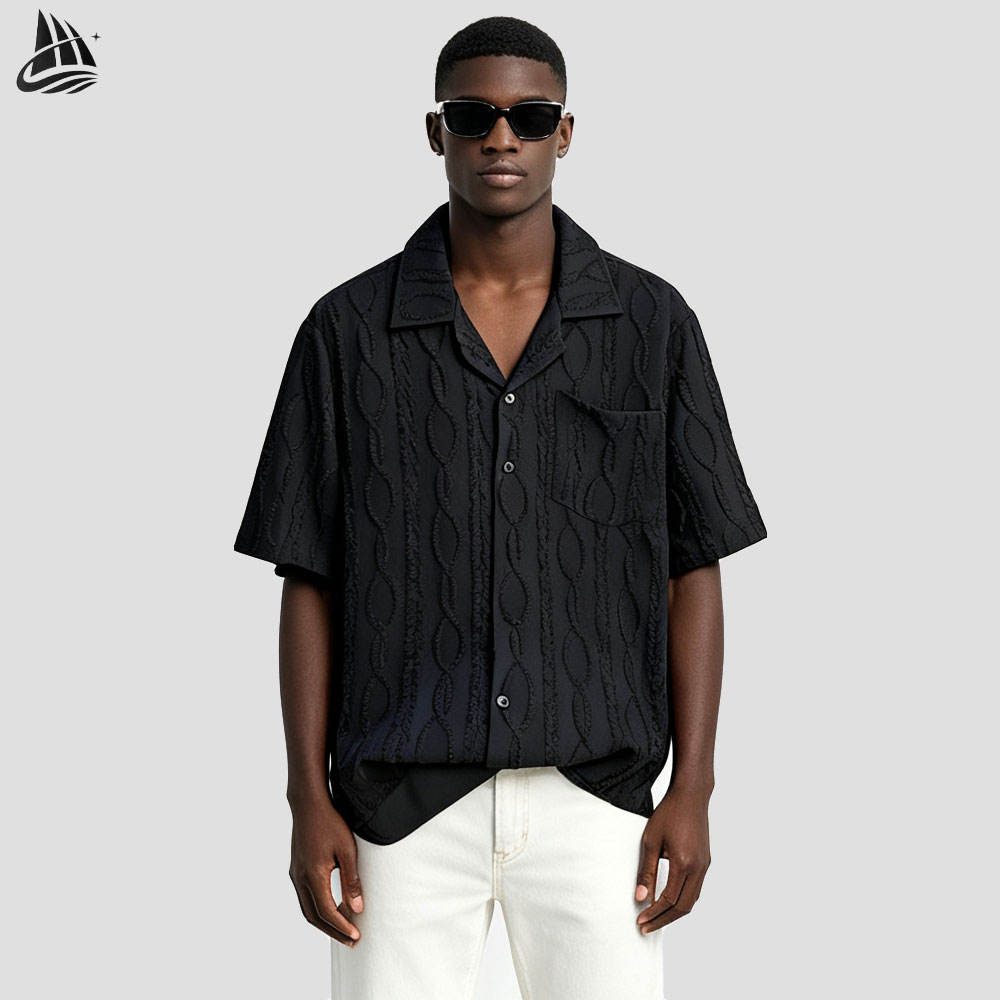
Detail. The collar rib is knitted tighter than the body so it recovers; a collar cut from body fabric reads flat on the hanger and gapes in wear.
Pilling
Why does knitwear pill and what can be done about it?
Pilling is short fibres working loose from the yarn and tangling into small balls, usually where the garment rubs: under the arm, across the chest where a bag sits, at the cuffs.
Three factors drive it: fibre length, twist and surface. Longer staple fibres and higher twist resist it; a brushed or loosely spun yarn accelerates it. On a 4-point pilling scale, 3 to 4 after the standard abrasion test is a workable target for a mid-price knit, and it is tested on the yarn rather than on the finished garment.
Ready body shapes that can be developed in knit or jersey are listed under custom tops, and the sequence from approved sample to bulk sits under manufacturing and production.
Two practical levers exist. Specify a combed or longer-staple yarn rather than a carded one, and avoid brushing the inside of a fine gauge garment where the abrasion is highest. Neither removes pilling; both move it from a first-month complaint to a second-season one.
Specification
What belongs on a knit tech pack
A knit specification is shorter than a woven one, and every line on it changes the price or the fit.
- Gauge, stated as a number, with the machine type where relevant
- Yarn count and ply, with fibre composition and staple type
- Stitch structure per panel: jersey, rib, cable, jacquard, intarsia
- Panel method: full-fashioned or cut and sew, with the seam type at shoulder, armhole and neck
- Relaxation and wash treatment before cutting, with the residual shrinkage target
- Measurements per size with tolerances, taken flat after relaxation
- Pilling target on the abrasion scale, tested on the bulk yarn
Where a knit fails inspection, the routes for rework and credit are set out in the guide to bulk order defects. The measurement line carries the most risk, because knit measurements are taken relaxed and a garment measured while stretched reads several centimetres wider. State the rest time — fifteen minutes flat is workable — and the tolerance, which on knitwear is wider than on woven: ±1/2 inch on body length and chest, ±1/4 inch on shoulder and sleeve.
INFULLSAIL, a custom streetwear and clothing manufacturer specializing in OEM/ODM production, specifies knitwear the same way, from gauge and yarn through to the linked seam. Minimum order is 100 pieces per style, per colour, with sizes mixable inside a colour. Sampling runs two to three weeks, the sampling fee is quoted up front and can only be offset against bulk when the bulk volume is large enough to absorb it, and bulk production follows sample approval at about three weeks.
Sampling
What does a knit sampling round actually test?
A knit sample is not a size check with a nicer surface. It tests whether the yarn, the gauge and the panel method produce the hand feel that was approved on paper, and most of that cannot be seen in a photograph.
Four things are settled in the first round. The stitch density, judged by holding the panel against a light so the loops read as a grid rather than a blur. The recovery of the rib, measured by stretching the cuff to 150% and letting it rest for fifteen minutes. The shrinkage, tested on a dyed panel rather than on greige. And the seam behaviour, which shows at the shoulder after the first wash rather than on the sample table.
A second round is usually needed when the yarn changes, because a substitution moves all four at once. That is why the yarn line on the specification names the count and the ply instead of describing the fibre only, and why a mill substitution should be re-sampled rather than approved by email.
INFULLSAIL provides custom T-shirt, hoodie, and streetwear manufacturing services for clothing brands, and treats a knit sample as a test of gauge and yarn rather than a photograph approval. Where a style is developed from a reference garment, the reference is measured relaxed and the numbers are carried onto the sheet before the first panel is knitted.
FAQ
What gauge should a streetwear knit sweater use
7 gauge for a standard mid-weight sweater with visible stitch definition at 300–400 GSM, or 5 gauge if the design depends on heavy cables and a substantial hand. 12 gauge suits fine knit shirts and lightweight layers around 180–220 GSM. The gauge follows the silhouette, not the season.
Is a higher gauge better quality
No. Gauge describes stitch size, and a fine gauge is not automatically a better garment. A 7 gauge sweater with a good yarn, linked seams and correct relaxation outlasts a 12 gauge one in a weak yarn with overlocked shoulders. Quality sits in the yarn, the making up and the wash control.
Why did my knit shrink after the first wash
Most often the panels were not relaxed or washed before cutting, so the 3–5% cotton shrinkage landed on the finished garment instead of on the fabric. The fix is a wash test on the bulk yarn, an allowance cut into the pattern, and a residual shrinkage target of under 3% written on the specification.
Can a knit be printed or embroidered
Yes, with limits. Embroidery on fine gauge needs a backing and a light design, because a dense stitch count distorts the loop structure. Printing on knit is usually replaced by jacquard or intarsia, since a plastisol print on a stretchy surface cracks at the seam. Where print is used, it is applied to a stabilised panel before making up.
What is the difference between linking and overlocking
Linking joins stitch to stitch on a dedicated machine, so the seam stretches and recovers with the knit. Overlocking sews a cut edge, which is faster and cheaper but adds bulk and restricts stretch. On fine gauge garments the difference is visible at the shoulder within a few wears.
How is knitwear priced
By machine time and yarn, not by fabric metres. A coarser gauge runs slower per panel, a full-fashioned panel takes a separate programme per piece, and intarsia adds hand finishing at the joins. The quotation itemises yarn, knitting, making up and finishing so a single change can be priced on its own.
Planning Your Next Streetwear Collection?
Send the gauge, the yarn and the silhouette you have in mind, and the knit specification comes back with the panel method and tolerances before sampling starts. Talk to our team