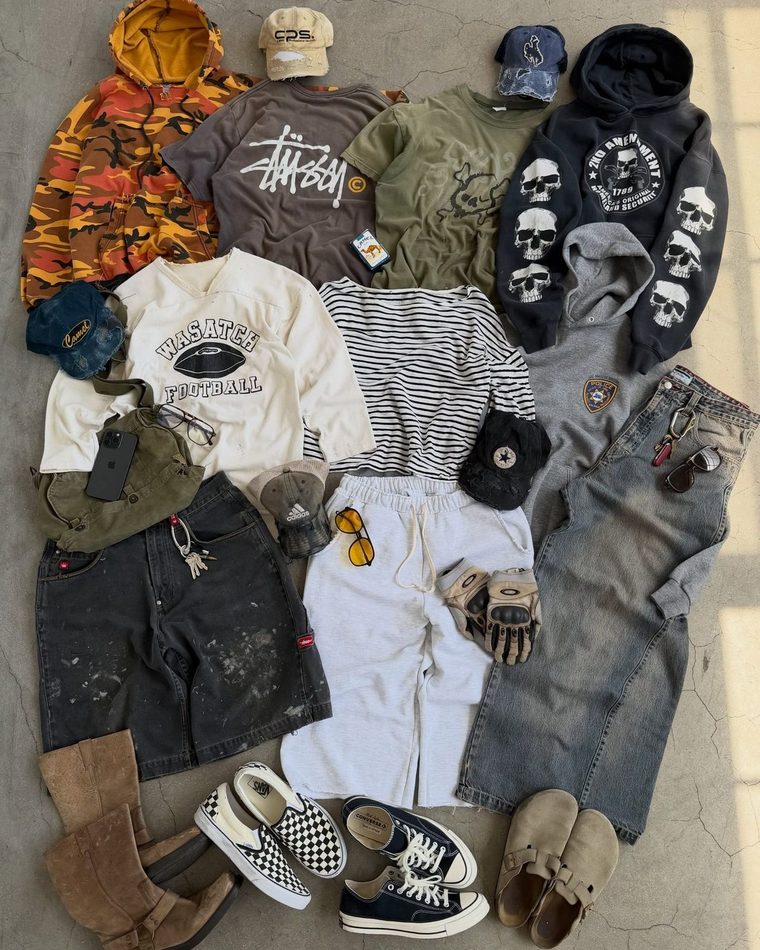
November Sourcing Show — What Buyers Asked For
Quick Answer
Buyers at the November sourcing show went straight for outerwear and washed finishes, and they checked fabric hand and seam construction before they asked about price.
- Jackets, hoodies and outdoor shells carried most of the walk-through traffic.
- Shade and hand were judged by touch, not by a photo on a screen.
- Minimum order and sampling time were the two questions that turned into follow-ups.
We spent 25 November at a sourcing show with our autumn range on the rail. The interesting part was not the footfall. It was the order in which buyers asked their questions, because that order tells a factory what actually decides an order.
Almost nobody opened with price. They opened with the fabric: how heavy is the canvas, does the fleece pill, is the wash repeatable. Price arrived after the hand and the seam had been checked, and by then the conversation had usually moved to minimums and to how long a sample would take.
This is a short report on what we saw, what buyers asked, and what it means if you are planning a small run rather than a container.
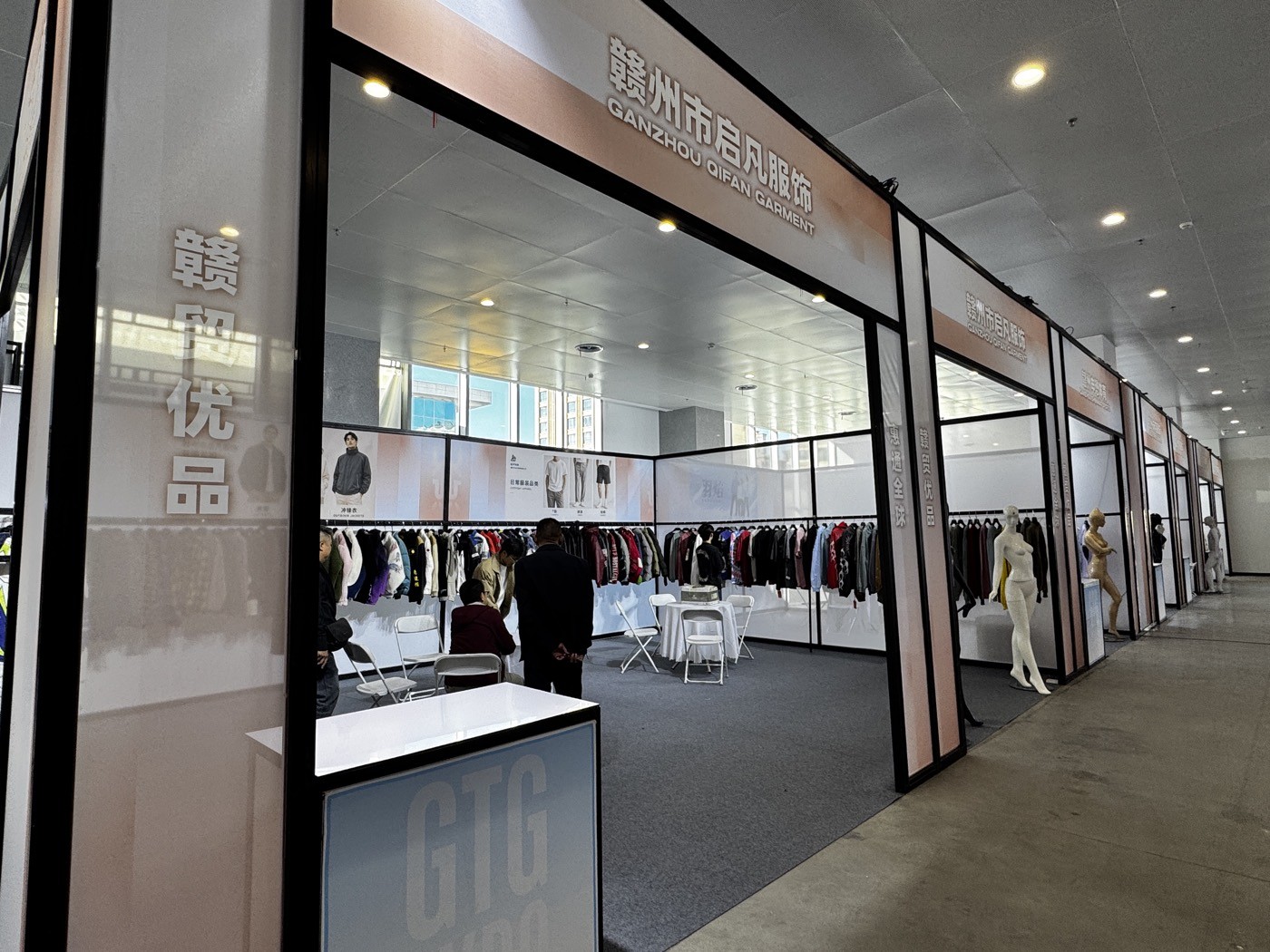
The stand frontage at the November show. Buyers read the category wall before they stepped inside, which is why the wall is worth designing as carefully as the garments.
Range
What was on the stand in November
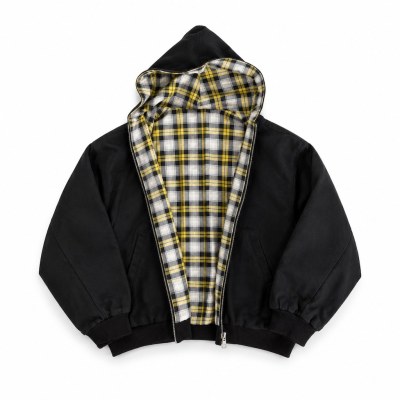
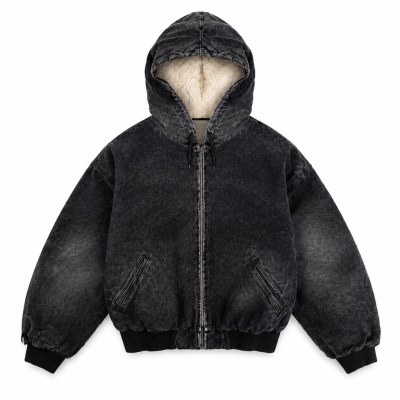
The rail was built around outerwear, because that is what the season asks for and what buyers travelled to see. Hoodies and sweats were the second stop, and everyday apparel — T-shirts, pants, shorts — was the third, mostly for buyers assembling a full collection rather than a single drop.
| Category | What buyers looked at first | What we showed |
|---|---|---|
| Work and utility jackets | Canvas weight, pocket construction, seam type at the elbow | Duck canvas shells in 10 oz and 12 oz, bar-tacked at every pocket corner |
| Hoodies and sweats | Fleece or loopback face, shrinkage after wash, cuff recovery | Heavyweight fleece with a measured residual shrinkage on the spec sheet |
| Outdoor shells | Handling noise, seam sealing, zip gauge | Lined shells with the zip and tape specified in the tech pack |
| Everyday apparel | Jersey weight, neckline recovery, print position | T-shirts and relaxed pants cut from the same size set used across the range |
Category order reflects what buyers asked to see first on the day, not a ranking of volume.
Questions
Which questions came up on every walk-through
Four questions repeated across the day, and they were the same four whether the buyer ran a boutique or a mid-size label.
The first was the minimum. The answer stays the same as it has been: 100 pieces per style, per colour, with sizes mixable inside the colour. That number surprised some visitors and calmed others, but it settled the shape of the conversation, because a 100-piece order is a size curve decision before it is a sewing decision.
The second was sampling time. A sample takes two to three weeks per round, and buyers who were planning a spring drop were already late if they had not started. Some had been told by other suppliers that a sample would take a week, which is possible only if the fabric is already in house and the pattern already exists.
The third was consistency across a reorder. This is the question that separates a first order from a relationship: a buyer who has been burned once by a shade shift asks about the dye lot before asking about the price.
The fourth was defect handling. What happens if 3% of a run arrives with a bad seam is not a hypothetical for anyone who has imported before, and a factory that answers it with a process rather than a promise keeps the conversation. The claim, rework and credit routes are set out in the guide to bulk order defects and remedies.
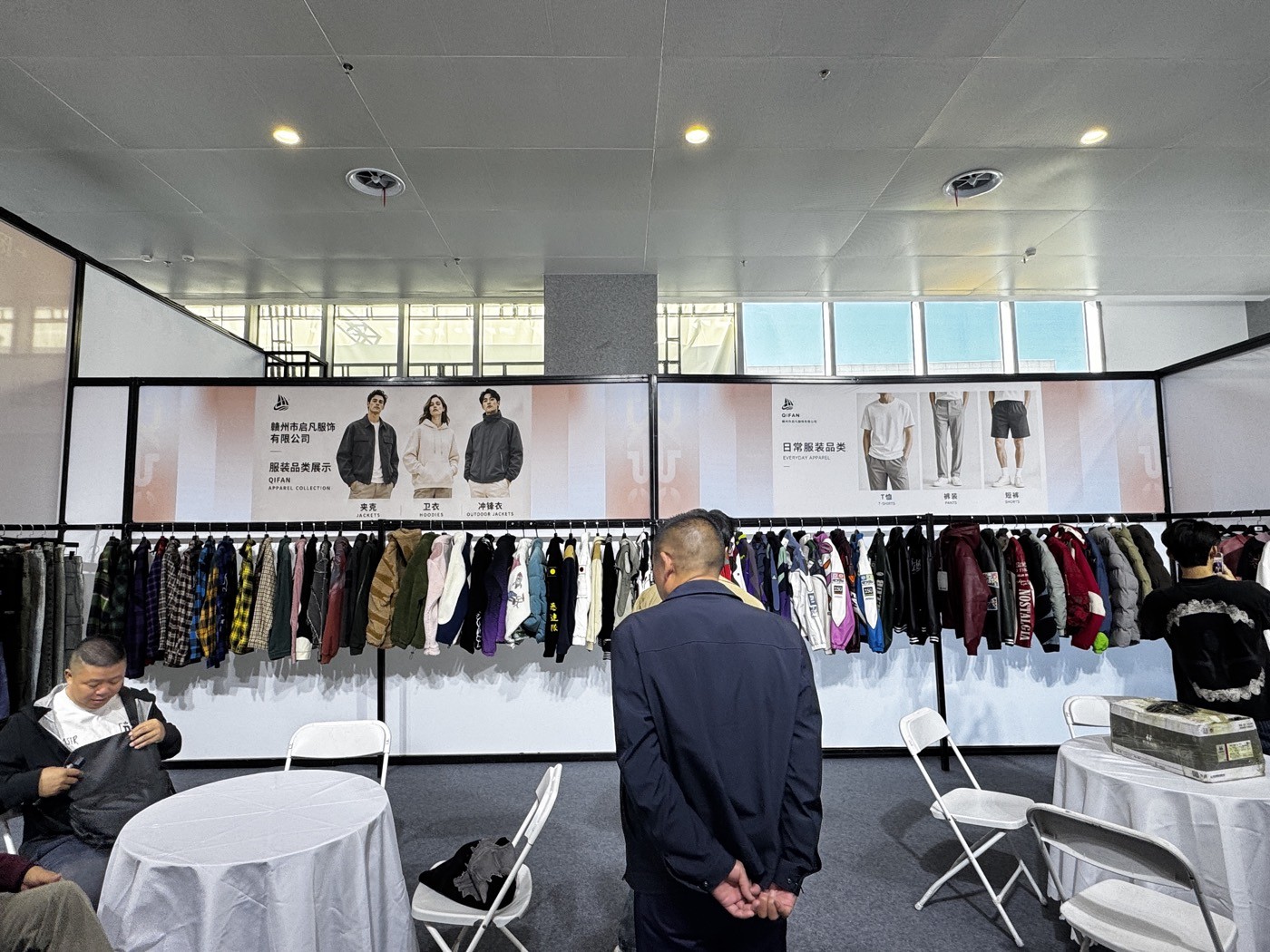
The category wall inside the stand. Splitting jackets, hoodies and shells into separate bays let buyers walk to the category they had come for instead of flipping through a single mixed rail.
Hand
What buyers checked by hand rather than by photo
Two things were checked physically by almost everyone: the inside of the garment and the pocket corner.
Opening the jacket and looking at the seam told them more than any photograph could. A flat-felled side seam and a bound edge read as a garment built to be worn; an overlocked raw edge inside a jacket that sells at a premium reads as a shortcut. On the pocket, a thumb went straight into the corner to feel whether there was a bar-tack under the fabric.
Fabric hand was the other test, and it is the one that cannot be answered remotely. A 12 oz duck that has been garment washed feels different from the same weight shipped rigid, and buyers who know their customer can tell in a second which one that customer will accept. The weight bands and what they do to a finished garment are covered in heavyweight cotton GSM ranges, and the finish side sits under fabrics and processes.
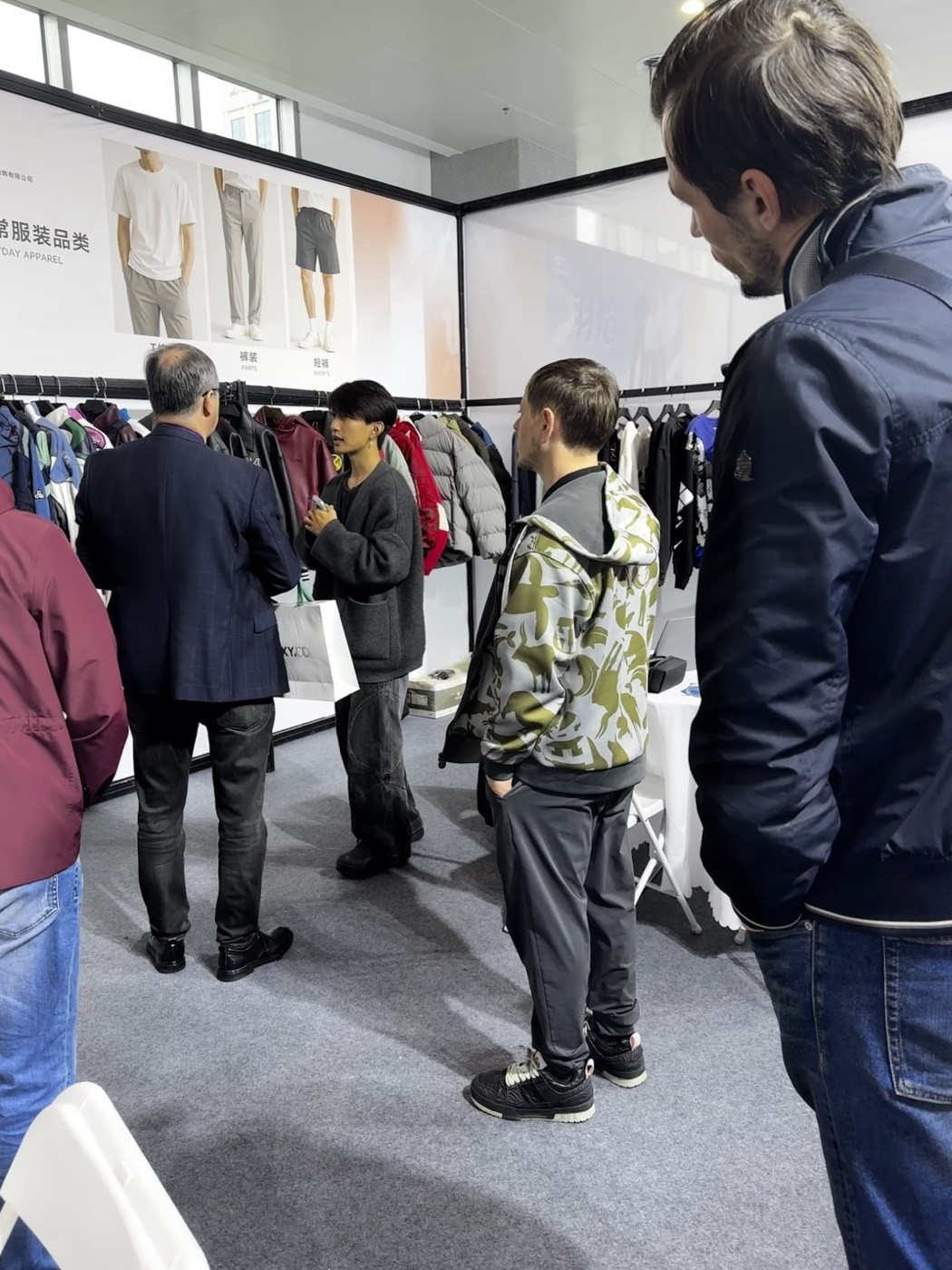
A walk-through in progress. The garment is turned inside out within the first minute, which is why the inside finish matters as much as the face fabric.
Small runs
What this means for a 100-piece run
The show confirmed something that is easy to forget when a range is designed on a screen: a small run is decided by the fabric and the pattern, not by the print.
At 100 pieces per style, per colour, the fabric minimum is the binding constraint. A canvas that only dyes in large lots will either carry a surcharge or push the lead time out, and that decision has to be made before the sample rather than after approval. It is the same reason a two-colour range at 100 pieces each is a 200-piece commitment in practice.
The second constraint is the size curve. A buyer who orders 100 pieces across five sizes has already made a forecast, and the sizes that do not sell are the ones that sit. Planning that curve is a separate exercise, covered in the note on size curve planning for 100-piece runs.
Next steps
How to brief a factory after a show
The buyers who moved fastest after the show were the ones who left with a written specification rather than a stack of business cards. The brief that produces a usable quotation has five parts.
- Style, category and silhouette, with the reference garment or a sketch
- Fabric weight and finish in numbers, not adjectives
- Seam type and reinforcement at the load points
- Colour count, size curve and total pieces per colour
- Target sample date and the date the bulk needs to land
With those five items, a quotation comes back comparable. Without them, two factories quote two different garments and the cheaper number is meaningless.
A sampling fee is quoted in the quotation and can only be offset against bulk when the bulk volume is large enough, so it is worth asking how that is calculated rather than assuming it disappears. Bulk production then runs about three weeks after sample approval, before shipping time is added.
FAQ
Was the show open to new buyers
Yes. The visitors we spoke to ranged from single-store boutiques to labels already running seasonal production, and the questions differed far less than the size of the business. A first-time buyer and an experienced one both asked about minimums, sampling time and reorder consistency.
Can samples be ordered after the show
Yes, and that is the usual sequence. A buyer leaves with the specification, sends it in writing, and the sample round starts once the fabric is confirmed. Sampling runs two to three weeks per round, and a second round is normal when a fit correction is needed.
What is the minimum order discussed at the stand
100 pieces per style, per colour, with sizes mixable inside the colour. A buyer testing two colourways of one style is therefore ordering 200 pieces, and the fabric has to be dyed in both lots — which is usually the schedule risk on a small programme.
Do show samples reflect bulk quality
They should, and asking is fair. A sample made from a different fabric lot or with a shortcut at the seam is the most common reason a bulk run disappoints. The practical check is to approve a sample that carries the same fabric weight, the same seam type and the same wash as the bulk order will.
Planning Your Next Streetwear Collection?
Send the category, fabric weight and size curve you have in mind, and the specification comes back with the seam and finishing details before sampling starts. Talk to our team